Katie Hobbs has spent nearly four years governing Arizona with a Republican-controlled Legislature.
That matters.
Unlike a governor working with a friendly majority, Hobbs has had to negotiate, veto, threaten vetoes and sometimes force lawmakers back to the table.
Depending on who you ask, that makes her either an effective check on partisan legislation or one of the most confrontational governors Arizona has had in years.
The record supports pieces of both arguments.
The case for Hobbs
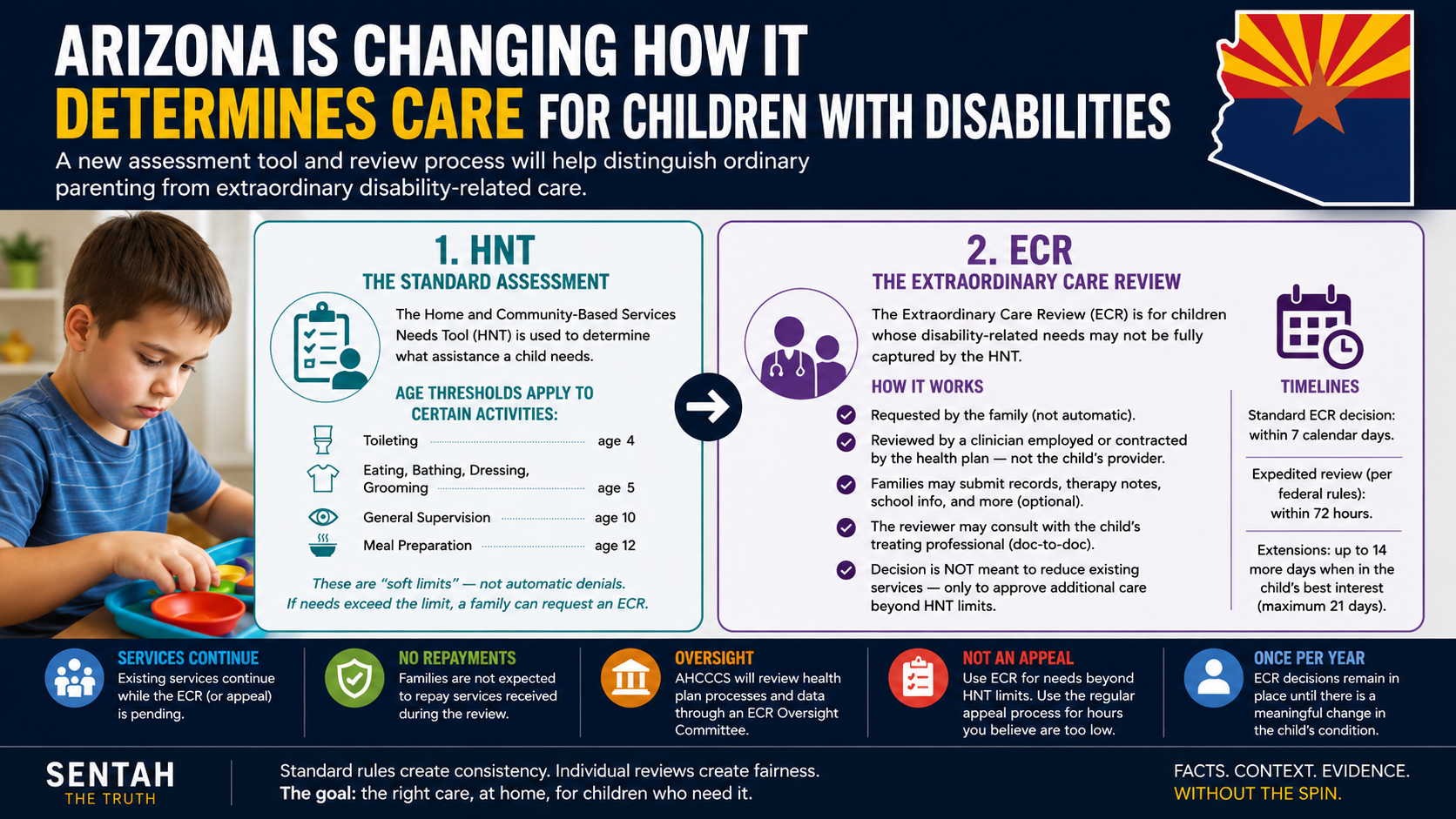
One of the clearest examples came during Arizona’s developmental-disability funding crisis.
In 2025, the future of services for nearly 60,000 Arizonans with developmental disabilities was uncertain as lawmakers fought over funding and proposed changes to the Parents as Paid Caregivers program.
Hobbs imposed a bill moratorium and refused to move forward with unrelated legislation until lawmakers reached a deal.
That tactic drew criticism.
It also worked.
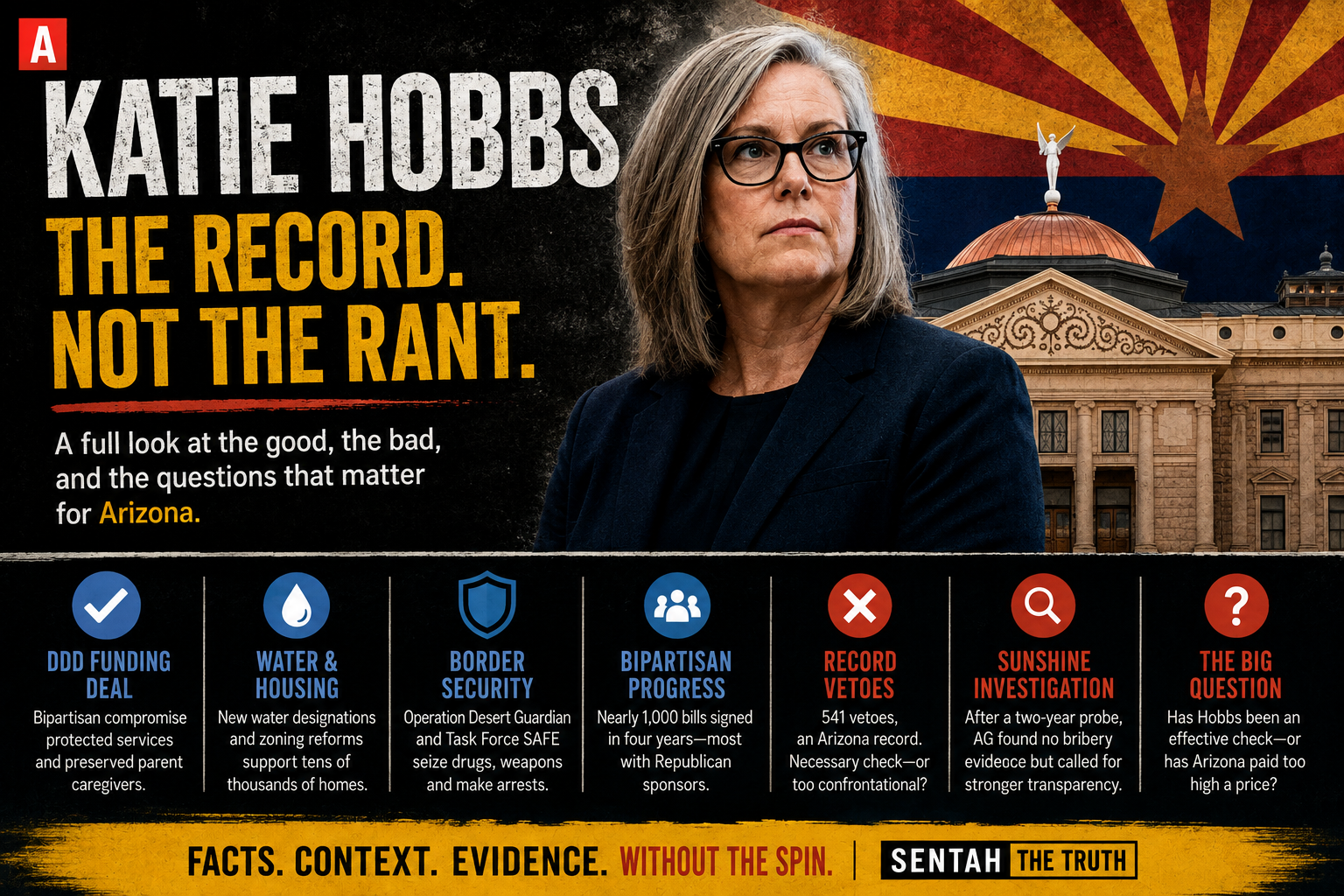
The final bipartisan compromise, HB 2945, funded DDD through the end of the fiscal year, preserved continuity of services, rejected proposed 50% cuts to parent caregivers, placed a 40-hour cap into statute and added accountability measures around program utilization.
For disability families, that was not an abstract political win.
It meant services continued.
It also showed something important about Hobbs’s governing style: she is willing to use the power of the governor’s office aggressively when she believes the Legislature will not move otherwise.
That same style has helped produce broader bipartisan results.
By July 2025, Hobbs’s office reported that she had signed 728 bipartisan bills. In 2026 alone, she signed another 264 pieces of legislation, bringing her four-year total to 993 signed bills.
That does not erase her veto record.
But it does complicate the claim that she is incapable of working across the aisle.
Water and housing
Hobbs can also point to measurable results on two of Arizona’s biggest long-term problems: water and housing.
Her administration created the Alternative Designation of Assured Water Supply program, or ADAWS, designed to allow growth while maintaining 100-year water protections.
In October 2025, the first Phoenix-area ADAWS designation in 25 years was approved for EPCOR, creating enough assured water capacity for as many as 60,000 new homes.
In March 2026, a Pinal County designation was projected to support more than 80,000 additional homes.
And Arizona’s first Ag-to-Urban groundwater approval was projected to allow 825 homes while saving more than 437 million gallons of water per year compared with the land’s previous agricultural use.
Those are real implementation numbers, not just campaign promises.
Whether those programs are enough to solve Arizona’s water and housing pressures is another question.
But they are tangible accomplishments.
Border security is more complicated than the slogans
Hobbs has also taken more enforcement action on the border than many of her critics acknowledge.
She created Operation Desert Guardian, directing state public-safety agencies to work with county sheriffs and federal law enforcement against cartels, drug trafficking and human smuggling.
By September 2025, the governor’s office reported more than 600 arrests and more than 900 pounds of drugs seized through Desert Guardian operations.
The broader Task Force SAFE operation had previously intercepted more than 19 million fentanyl pills, thousands of pounds of other drugs and hundreds of weapons at ports of entry.
Critics can still argue Arizona needs a tougher border strategy.
But portraying Hobbs as having done nothing on border enforcement does not match the record.
ESA: reform, not abolition
Hobbs’s position on Arizona’s Empowerment Scholarship Account program is also more nuanced than the usual campaign shorthand.
Her administration has pushed for tighter oversight of the universal ESA expansion, including fingerprint requirements for educators receiving public funds, stronger financial accountability and protections for students with disabilities.
That is different from saying the original ESA program should disappear.
Her stated position has repeatedly distinguished between the original program serving students with disabilities and other targeted populations, and the later universal expansion.
Supporters see that as overdue accountability.
ESA advocates often see it as an attempt to restrict parental choice.
That disagreement will remain one of the defining policy fights of the governor’s race.
Then there is the veto pen
If Hobbs has a governing identity, it may be this one.
She vetoes bills.
A lot of them.
During her first three years, she vetoed 390 bills. By the end of the 2026 session, that number had grown to 541, an Arizona record.
Republicans point to that number as evidence that Hobbs obstructs the Legislature instead of governing with it.
Hobbs argues that many of those bills were partisan measures, repeats of legislation she had already rejected, or bills she considered harmful or unworkable.
There is evidence for that argument too.
In 2026 alone, lawmakers reintroduced 87 bills Hobbs had previously vetoed.
Arizona Capitol Times found that 90 of her 541 vetoes involved bills she had rejected more than once.
So the raw veto number tells only part of the story.
But 541 vetoes are still 541 vetoes.
At some point, voters have to decide whether they see Hobbs as a necessary counterweight or an executive too willing to govern through confrontation.
Governing by ultimatum
That criticism gets stronger when Hobbs uses broad veto threats to force negotiations.
She did it during the DDD crisis.
She did it again during budget disputes.
That style can be effective.
It can also look like holding unrelated legislation hostage until lawmakers give the governor what she wants.
Supporters call it leverage.
Critics call it brinkmanship.
Both descriptions fit depending on the case.
And that may be the central question about Hobbs’s leadership:
Does she force compromise because divided government requires it, or does she create unnecessary conflict because confrontation is her preferred tool?
The Sunshine Residential investigation
Then there is the controversy that has followed Hobbs for the past two years.
Sunshine Residential Homes, a state contractor, received rate increases after political contributions connected to Hobbs.
That prompted a lengthy investigation into whether there had been a quid pro quo.
The allegation was serious.
The final finding matters just as much.
On August 21, 2026, Arizona Attorney General Kris Mayes announced that after two years of investigation, interviews, reviews of campaign-finance and procurement records, bank documents, state emails and more than 100,000 documents, investigators found no evidence of the quid pro quo required to support a bribery charge.
That means the investigation did not establish bribery.
It would be irresponsible to write otherwise.
But Mayes also said the case exposed a need for stronger rules governing political donations from state contractors and called for legislative reform.
So the fairest conclusion is neither “Hobbs was cleared of everything” nor “Hobbs was caught in pay-to-play.”
It is this:
The investigation did not find evidence sufficient to establish bribery, but the circumstances were troubling enough that Arizona’s attorney general still called for stronger transparency laws.
That belongs in the record.
DDD is also a management question
There is another side to Hobbs’s DDD victory.
Yes, she ultimately protected services and helped force a bipartisan agreement.
But the funding crisis developed during her administration.
Republican lawmakers argued that the shortfall reflected poor forecasting and expansion of costs without sufficient legislative oversight.
Those claims should be treated as political criticism rather than settled fact.
Still, they raise a fair question.
A governor deserves credit for helping solve a crisis.
A governor also has to answer for whether better management could have prevented the crisis from becoming so severe in the first place.
Both can be true.
So what has Katie Hobbs actually done for Arizona?
She has forced compromise in a divided government.
She helped protect developmental-disability services.
She has signed hundreds of bipartisan bills.
Her administration has produced measurable water and housing initiatives.
She has expanded border-enforcement coordination and pushed for more oversight of the ESA program.
She has also vetoed more bills than any Arizona governor before her.
She has repeatedly used veto threats as leverage.
Her administration has faced serious questions over management and transparency.
And although the Sunshine Residential investigation did not establish bribery, the controversy was significant enough to prompt calls for reform.
Like Andy Biggs, Hobbs has been in public office long enough that supporters and opponents can each build a very selective version of her record.
That is the easy part.
The harder question is what happens when we put the entire record on the same page.
Has Katie Hobbs been an effective check on a Republican Legislature?
Or has Arizona paid too high a price for a governing style built around vetoes, confrontation and brinkmanship?
That is ultimately for Arizona voters to decide.
Same questions. Same scrutiny. Same standard.
Facts before sides