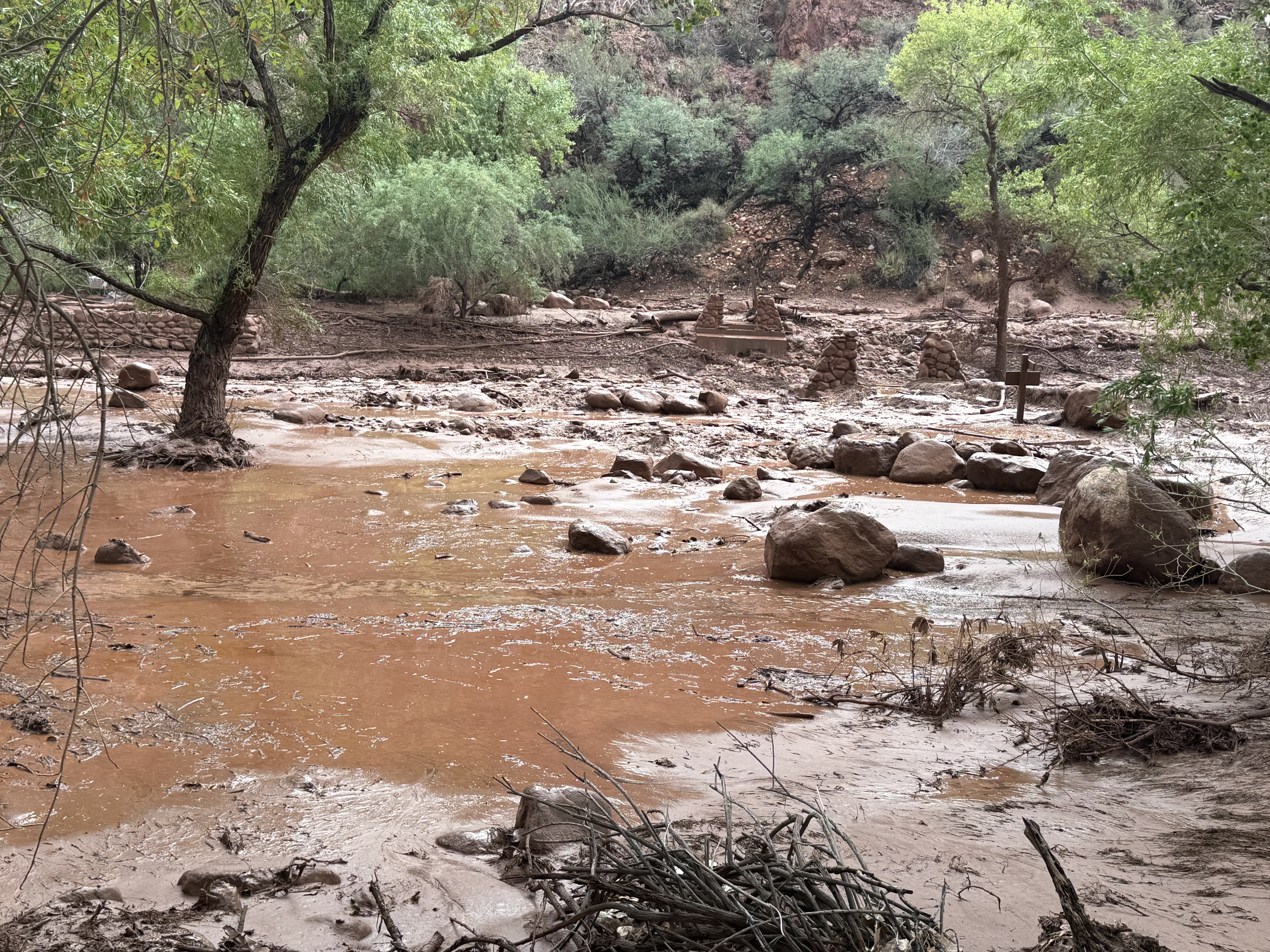
Remnants of stone bridge pylons along Bright Angel Creek after flash flooding destroyed the footbridge on August 29, 2026. Photo: National Park Service/J. Thompson.
A devastating flash flood inside Grand Canyon National Park has killed at least two people, left hikers unaccounted for and severely damaged the water system that supplies one of Arizona’s most visited destinations.
The flooding struck the Bright Angel Canyon and Phantom Ranch area Saturday after heavy rainfall caused Bright Angel Creek to rapidly overflow.
More than 60 people were evacuated from the affected area as National Park Service personnel and the Arizona Department of Public Safety responded.
Search and recovery operations continued Monday.
Officials have said the number of people potentially unaccounted for remains fluid as investigators work to determine who was actually inside the canyon when the flooding occurred. The National Park Service has asked anyone with information about hikers or backpackers who were along the Bright Angel Creek corridor on August 29 to contact investigators.
The disaster also caused extensive damage to some of the Grand Canyon’s most important infrastructure.
Preliminary assessments indicate approximately 40% of the Transcanyon Waterline was damaged or destroyed.
The 12.5-mile pipeline carries drinking water from Roaring Springs through the canyon and ultimately supplies facilities on the South Rim. It also provides water used for fire suppression and serves portions of the inner canyon.
The system was already undergoing a massive rehabilitation project costing more than $200 million.
The aging pipeline has experienced more than 85 major breaks since 2010, according to reporting from The Associated Press, and work has been underway since 2023 to replace significant portions of the system and improve the park’s long-term water supply.
Now, a substantial portion of that infrastructure has been damaged before the larger replacement project could be completed.
The National Park Service has imposed Stage 4 water restrictions, and overnight lodging inside Grand Canyon National Park has been suspended. The South Rim remains accessible for daytime visitors, but several trails, campgrounds and inner-canyon areas affected by the flooding are closed.
Nearly all footbridges crossing Bright Angel Creek were also destroyed or damaged.
Phantom Ranch, Bright Angel Campground and the North Kaibab Trail are among the areas closed until further notice.
The flooding comes as northern Arizona remains in its summer monsoon season, when intense thunderstorms can produce dangerous flash floods with little warning. Additional rain could complicate search, recovery and damage-assessment operations.
For Arizona, the consequences extend beyond the immediate disaster.
Grand Canyon National Park draws millions of visitors annually and is a major component of northern Arizona’s tourism economy. Significant disruption to lodging, trails and the park’s water infrastructure could have effects lasting well beyond this week.
For now, however, the priority remains finding those who may still be missing and determining the full extent of the damage.
The National Park Service is asking anyone who knows of hikers or backpackers who were in the Bright Angel Creek corridor, along the North Kaibab Trail or near Phantom Ranch on August 29 to provide that information to investigators.
This is a developing story. Sentah the Truth will update this report as additional information is confirmed.