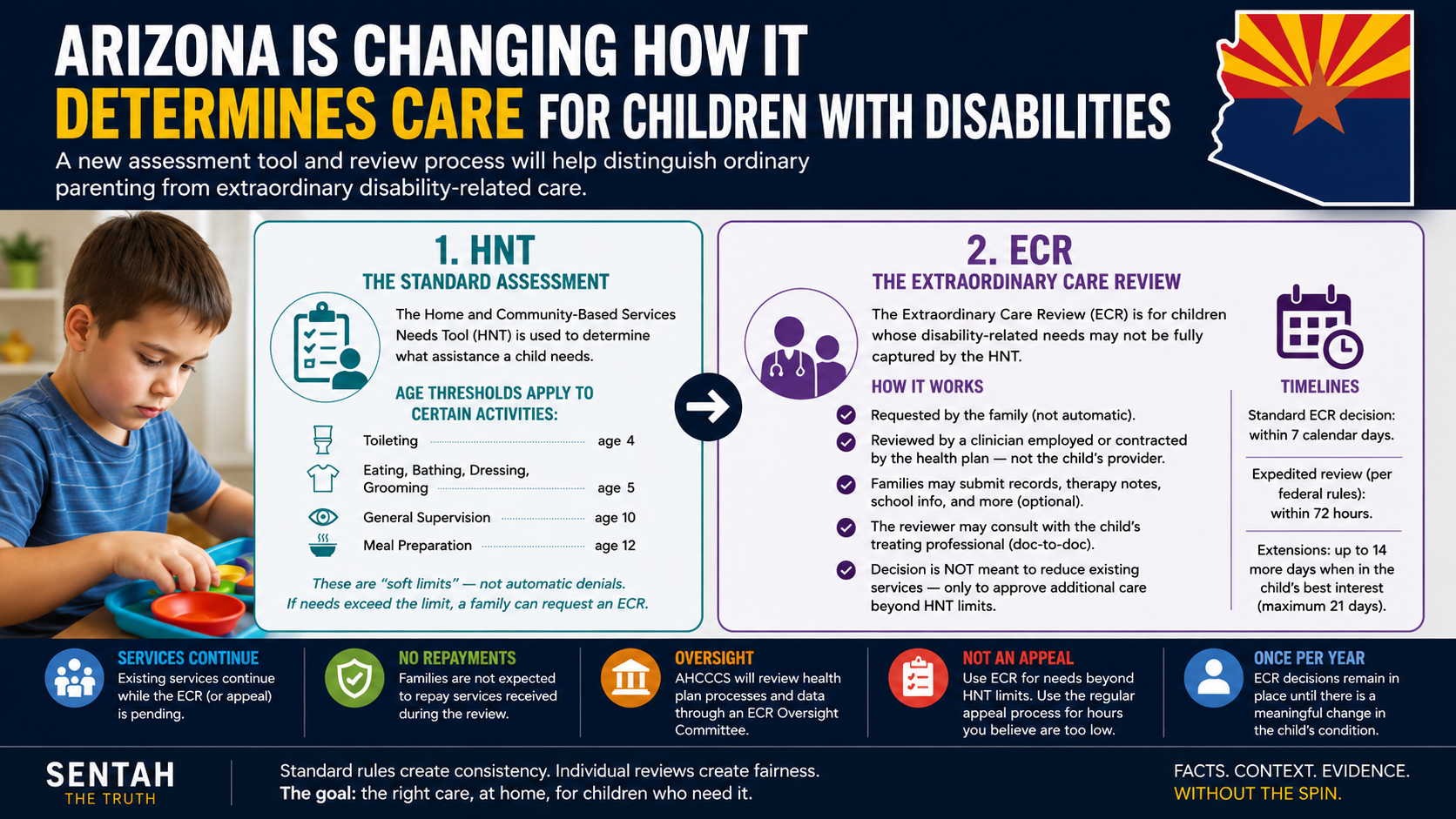
Arizona is preparing to change the way it determines how much home- and community-based assistance children with disabilities need.
The changes affect services that can help with everyday activities such as bathing, dressing, eating, toileting and remaining safe at home. For children whose disabilities require substantially more assistance than other children their age, those assessments can help determine how much support Arizona authorizes.
At the center of the change is the Home and Community-Based Services Needs Tool, commonly shortened to the HNT. It is an assessment used to determine what assistance a person needs while living at home or in the community rather than in an institutional setting.
Arizona is also developing an additional clinical review called the Extraordinary Care Review, or ECR. It is intended for children whose disability-related needs may not be adequately captured by some of the standardized limits built into the assessment.
Put simply, the HNT establishes the standard assessment process. The ECR provides another level of review when a child’s needs do not fit neatly within those standards.
And that matters because the new assessment attempts to answer a deceptively difficult question: When does ordinary parenting become extraordinary disability-related care?
Where does ordinary parenting end?
Parents help young children bathe. They prepare meals, help them dress, assist with toileting and keep them safe. Arizona’s Medicaid system is not intended to reimburse ordinary parenting simply because a child has a disability.
But disability can fundamentally change what those ordinary-looking activities require.
Helping a typically developing young child get dressed is parenting. Providing extensive hands-on assistance to a child who cannot dress independently because of significant functional limitations is different. Preparing a child’s dinner is ordinary parenting. Preparing food in a specialized manner because of documented medical, physical or behavioral needs can require an entirely different level of care.
Supervision presents an even harder distinction. Every parent supervises a child. But maintaining close or constant proximity because of uncontrolled seizures, severe self-injury, dangerous ingestion behavior or significant risk of running away is not necessarily comparable to supervising another child of the same age.
Arizona’s challenge is creating consistent rules without pretending that children of the same age—or even children with the same diagnosis—necessarily have the same abilities or needs.
The new assessment uses age thresholds
The proposed HNT attempts to create that consistency partly through age thresholds.
According to a summary of two public forums conducted by the Arizona Health Care Cost Containment System, the state agency that administers Arizona’s Medicaid program, standard toileting is not assessed below age 4. Standard eating and feeding, bathing, dressing and grooming begin at age 5. General attendant-care supervision has an age threshold of 10, while meal preparation begins at age 12. AHCCCS_HNT_ECR_Forums_Summary.pdf
Those aren’t the only rules in the tool. Specialty categories exist for certain documented medical and behavioral needs. Specialty meal preparation, specialty feeding and specialty toileting, for example, do not have the same minimum-age requirements. The tool also includes specialty supervision for serious safety risks. AHCCCS_HNT_ECR_Forums_Summary.pdf
AHCCCS describes the age thresholds as “soft limits.”
That phrase deserves some explanation, because “soft” does not mean a support coordinator can simply ignore the threshold.
If a child is below the specified age, the activity generally cannot be assessed through the ordinary process. The tool records that it was not assessed because of the child’s age. If the family believes the child’s disability creates an extraordinary need, the family can request an Extraordinary Care Review. AHCCCS_HNT_ECR_Forums_Summary.pdf
So the threshold is not necessarily a final denial.
But it is a gate.
What is an Extraordinary Care Review?
The Extraordinary Care Review is the mechanism intended to account for children whose needs fall outside certain standardized limits.
It is available to members under 18 and is used primarily when an age threshold prevents an activity from being assessed or when a child may need more than 14 hours per week of habilitation—services intended to help develop or maintain skills necessary for daily living. AHCCCS_HNT_ECR_Forums_Summary.pdf
The family must actively request the review; it does not automatically occur simply because a child’s circumstances appear unusual. The draft assessment includes a place for the parent or other health-care decision-maker to indicate whether they want information about the ECR and whether they want to pursue one for that assessment. AHCCCS_HNT_ECR_Forums_Summary.pdf
Families may provide therapy notes, behavioral treatment plans, school records, recent medical information and other supporting documents. According to the forum summary, however, submitting additional documentation is optional and declining to do so is not supposed to count against the child. The health plan already has access to existing utilization records, assessments and case notes. AHCCCS_HNT_ECR_Forums_Summary.pdf
An ECR is also different from an appeal. If an activity was fully assessed and the family simply disagrees with the number of hours authorized, the family uses the normal appeal process. A family can also appeal an ECR decision if it disagrees with the outcome. AHCCCS_HNT_ECR_Forums_Summary.pdf
Who decides whether care is extraordinary?
This may become one of the most important parts of the new system.
The Extraordinary Care Review will not be decided by the child’s regular support coordinator or by the child’s own treating or direct-care provider. Instead, it will be conducted by clinicians employed or contracted by the health plan responsible for the child’s long-term-care services. AHCCCS_HNT_ECR_Forums_Summary.pdf
AHCCCS has identified a range of professionals who may be eligible to perform these reviews, including developmental pediatricians, behavioral-health providers, physical and occupational therapists, speech-language pathologists, board-certified behavior analysts, psychologists and other professionals with relevant pediatric expertise. A reviewer may speak directly with the child’s treating professional for additional information, although such a consultation is allowed rather than required. AHCCCS_HNT_ECR_Forums_Summary.pdf
There is a logical reason for preventing a child’s own provider from making the final decision. A provider whose agency could receive additional reimbursement from additional authorized hours could have a financial interest in the outcome.
But the alternative structure raises a different question.
The clinician conducting the review will work for, or be contracted by, the health plan responsible for managing the cost of the services being requested.
That does not establish a conflict or suggest that clinicians will make improper decisions. It does create a legitimate independence question: How will Arizona ensure that a clinical decision about extraordinary care is insulated from the financial interests of the organization responsible for paying for that care?
AHCCCS has outlined safeguards. Health plans must submit their ECR operational plans to AHCCCS for approval, and AHCCCS plans to establish an ECR Oversight Committee to examine health-plan processes and review data after implementation. AHCCCS_HNT_ECR_Forums_Summary.pdf
Whether those safeguards are sufficient will become clearer only after families begin using the process.
How quickly must Arizona make a decision?
Timing matters when the subject is necessary care.
According to the AHCCCS forum summary, the standard ECR decision is subject to a seven-calendar-day prior-authorization timeframe. An extension of up to 14 additional days may be permitted when it is demonstrably in the member’s best interest—not simply because the health plan needs more time. AHCCCS_HNT_ECR_Forums_Summary.pdf
There is another federal deadline worth understanding.
Federal Medicaid managed-care rules require an expedited prior-authorization decision within 72 hours when the circumstances qualify for expedited review. The ordinary prior-authorization deadline is seven calendar days.
That does not mean every Extraordinary Care Review has a 72-hour deadline. The seven-day timeframe is the standard described by AHCCCS. The 72-hour federal requirement applies to qualifying expedited prior-authorization decisions.
AHCCCS has sought additional flexibility from the federal government over ECR processing time. According to the forum summary, federal officials previously denied broader flexibility around the seven-day requirement, while Arizona planned to seek additional time through its larger Medicaid waiver renewal. AHCCCS_HNT_ECR_Forums_Summary.pdf
If a health plan misses the applicable deadline, the ECR is not automatically approved or denied. The review still must be completed, and AHCCCS has said repeated delays could result in corrective or administrative action. AHCCCS_HNT_ECR_Forums_Summary.pdf
What happens to existing services while families wait?
This is another area where the details matter.
According to the forum summary, existing services are not supposed to be reduced while an ECR or subsequent appeal is pending. Families are also not supposed to face a clawback requiring them to repay the cost of services received during the ECR process. AHCCCS_HNT_ECR_Forums_Summary.pdf
The ECR itself is not designed to reduce existing assessed hours. Its purpose is to determine whether additional care is justified because an age threshold or the habilitation threshold prevented that care from being authorized through the ordinary assessment. AHCCCS_HNT_ECR_Forums_Summary.pdf
Once an ECR determination is made, the forum summary says it is intended to remain in place until there is a meaningful change in the child’s condition. Families should not have to repeat the extraordinary-care process every few months simply because another routine planning meeting occurs. AHCCCS_HNT_ECR_Forums_Summary.pdf
That distinction matters because routine 90-day meetings are not supposed to constitute full comprehensive reassessments. Comprehensive reassessment generally occurs annually or following a change in condition. AHCCCS_HNT_ECR_Forums_Summary.pdf
This is not simply a “paid parent” assessment
The HNT debate has become intertwined with Arizona’s broader debate over parents who work as paid caregivers for their children with disabilities.
But those are not the same thing.
What is commonly called Parents as Paid Caregivers is a service-delivery model within Arizona’s broader Medicaid long-term-care system. It allows qualified parents to join the direct-care workforce and provide certain services their children have been assessed and authorized to receive.
The HNT addresses the child’s underlying need for services—not simply whether Mom or Dad can be paid to provide them.
The forum summary specifically states that the Parents as Paid Caregivers service model is moving forward as currently implemented under Arizona’s broader federal Medicaid waiver, while the HNT and ECR changes apply more broadly to affected children. AHCCCS_HNT_ECR_Forums_Summary.pdf
That distinction becomes particularly important when discussing costs. A direct-support professional is delivering an authorized service whether that qualified worker is a parent or a non-parent employee. Changing who provides the service does not, by itself, establish that the child’s assessed need disappeared.
Cost is part of the story, but it isn’t the whole story
Arizona has legitimate fiscal concerns.
Spending on developmental-disability services has increased significantly, and a recent Auditor General review criticized the state over implementation of cost-control measures. Taxpayers have every right to expect Arizona to ensure that services are medically necessary, assessments are accurate and public dollars are appropriately spent.
The HNT is part of Arizona’s effort to create greater consistency and distinguish ordinary parental responsibilities from extraordinary disability-related care.
But reduced spending on one service is not automatically equivalent to net taxpayer savings.
Arizona itself provides home- and community-based services in part because they are considered more cost-effective than institutional care. AHCCCS_HNT_ECR_Forums_Summary.pdf If an assessment identifies genuinely unnecessary services, eliminating them can produce legitimate savings. If necessary care simply shifts to another provider, becomes unpaid family care, goes unmet or eventually contributes to the need for a more intensive setting, the fiscal calculation is different.
That doesn’t mean every reduction leads to a group home or institution. It means the actual outcome matters when calculating what taxpayers ultimately save.
Sentah is separately reviewing current Arizona residential and institutional-care costs. Those figures deserve context, but they should not distract from the immediate question surrounding the HNT and ECR.
A standardized tool meets decidedly nonstandard children
There is a strong argument for consistency.
Two children with comparable needs should not receive dramatically different levels of support simply because they have different support coordinators. Clear standards can improve accountability, reduce inappropriate authorizations and give families and taxpayers greater confidence that decisions are based on need rather than geography or individual interpretation.
But children aren’t standardized.
Two 8-year-olds with the same diagnosis can have profoundly different functional abilities. One may eat, dress, bathe and use the bathroom independently. Another may require hands-on assistance with every one of those activities. One may safely spend time without constant observation. Another may require someone within arm’s reach because of seizures, self-injury, choking, elopement or another serious safety risk.
A standardized assessment can establish a baseline.
The Extraordinary Care Review is supposed to account for the child who doesn’t fit that baseline.
According to the forum summary, AHCCCS was targeting December 1, 2026 for implementation, followed by reassessments using the updated HNT within approximately 90 days. The summary cautions that December 1 was an anticipated implementation date rather than a guarantee. AHCCCS_HNT_ECR_Forums_Summary.pdf
There are still legitimate questions to answer before and after implementation. How consistent will decisions be across health plans? How often will clinicians speak directly with a child’s treating professionals? How will AHCCCS monitor denial and approval patterns? Will families understand when to request an ECR rather than an appeal? And will a seven-day process function as intended when potentially thousands of children require individualized review?
None of those questions proves the new system will fail.
They are reasons to watch it closely.
Ultimately, Arizona’s new assessment system will not be judged by how neatly children fit into its boxes.
It will be judged by what happens when they don’t.
Facts before sides.