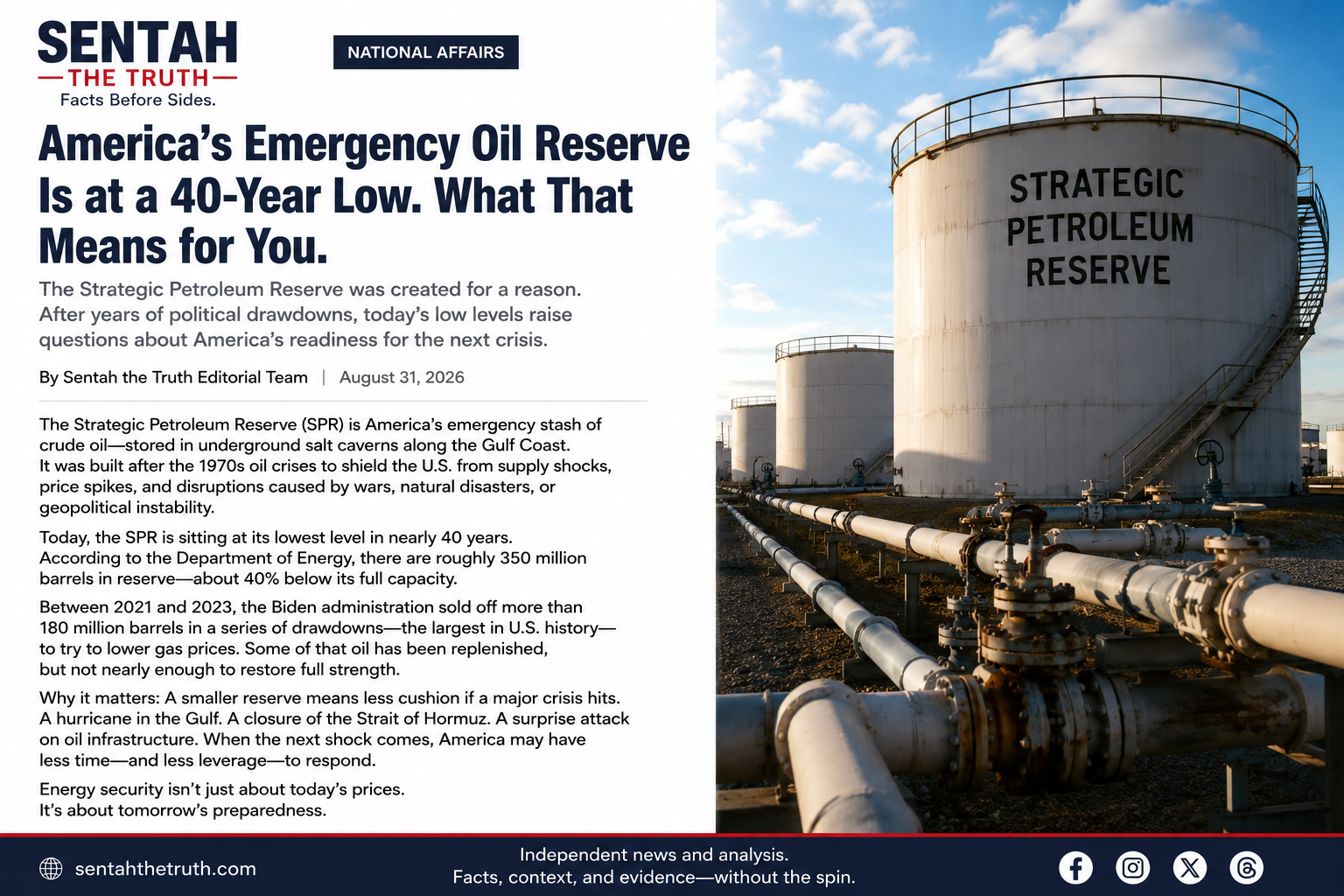
The United States keeps hundreds of millions of barrels of crude oil underground along the Gulf Coast for a reason.
The Strategic Petroleum Reserve, commonly known as the SPR, was created after the energy shocks of the 1970s to give the country an emergency supply of oil during major disruptions. It is supposed to buy time when war, natural disasters or other crises interrupt normal supplies.
Right now, America is using that cushion.
Federal data show the SPR held 289.7 million barrels of crude oil as of August 21, the lowest level since 1982. Just five weeks earlier, the reserve held more than 311 million barrels.
The decline comes while oil markets remain under pressure from the continuing conflict involving the United States and Iran. Shipping through the Strait of Hormuz — one of the most important oil transit routes in the world — has been disrupted, and renewed military activity has pushed crude prices higher again.
The reserve is doing exactly what it was designed to do.
The harder question is how much protection will remain if the current crisis gets worse — or another one begins before the reserve can be rebuilt.
WHAT EXACTLY IS THE STRATEGIC PETROLEUM RESERVE?
The SPR is not simply a collection of giant above-ground tanks.
Most of the crude is stored deep underground in salt caverns along the Texas and Louisiana Gulf Coast. The system was created in the 1970s after oil embargoes exposed how vulnerable the United States could be to disruptions in global energy supplies.
It is not meant to replace the American oil industry. It is an emergency buffer.
When supplies are suddenly interrupted, the federal government can move crude from the reserve into the market while producers, refiners and global suppliers adjust.
That can help reduce the shock of a major disruption, but the reserve is finite. Every barrel released today is a barrel that cannot immediately be used for the next emergency.
WHY IS THE RESERVE FALLING SO QUICKLY?
The current drawdown is part of an international response to disruptions caused by the Iran conflict.
In March, 32 members of the International Energy Agency agreed to release a combined 400 million barrels of oil and petroleum products from emergency reserves.
The United States committed 172 million barrels from the SPR. The Department of Energy said the releases would take approximately 120 days to deliver.
DOE has since conducted a series of emergency exchanges as it works through the broader commitment.
The result is visible in federal inventory data.
The SPR held 311.4 million barrels on July 17. By August 21, that number had dropped to 289.7 million.
And the drawdown may not be finished.
Reuters reported that completing the planned releases could eventually push the reserve to roughly 243 million barrels.
IS AMERICA RUNNING OUT OF EMERGENCY OIL?
No.
Nearly 290 million barrels is still an enormous amount of crude, and saying the United States has “no emergency oil left” would be misleading.
But the size of the reserve matters because its purpose is to give policymakers options during a crisis.
A smaller reserve means fewer barrels are available if another disruption occurs before replenishment is complete — whether that is another escalation in the Middle East, damage to energy infrastructure, a major Gulf Coast hurricane or an unrelated global supply shock.
The concern is not that the SPR suddenly becomes useless at a particular number.
The concern is that the margin for responding to the next emergency keeps shrinking.
THERE IS ALSO A PHYSICAL INFRASTRUCTURE ISSUE
The SPR is more than an inventory figure.
Its crude is stored in enormous underground salt caverns, supported by wells, pipelines, pumps and other infrastructure that has been operating for decades.
Reuters reported that experts and people familiar with the system have raised concerns that operating below roughly 250 million barrels could put additional strain on the reserve’s aging infrastructure and reduce its flexibility.
That does not mean the reserve stops working at 249 million barrels.
It does mean there is a practical difference between drawing down oil from a spreadsheet and operating a massive underground storage system at historically low inventory levels.
THE GOVERNMENT SAYS THE OIL WILL COME BACK
There is an important distinction in the current release that often gets lost in political arguments.
Much of this oil is being moved through an exchange, not simply sold and gone forever.
Under the exchange structure, companies receive crude from the SPR now and agree to return oil later, typically with additional barrels added as a premium.
When the 172-million-barrel action was announced, Energy Secretary Chris Wright said the United States had arranged to receive approximately 200 million barrels back within the following year — about 20% more than the amount being drawn down.
If that occurs on schedule, the emergency action would eventually rebuild the reserve rather than permanently remove all of the oil being released.
But there is still a timing problem.
The replacement barrels are not underground today.
VENEZUELA MAY ALSO BECOME PART OF THE REFILL PLAN
President Donald Trump said Sunday that the United States intends to use Venezuelan oil to help refill the Strategic Petroleum Reserve.
The announcement follows a new U.S.-Venezuela oil arrangement, but Venezuela’s petroleum industry has suffered from years of underinvestment and infrastructure problems. Reuters reported that it remains unclear how quickly Venezuelan production could rise enough to make a meaningful contribution to rebuilding the reserve.
That means there is a difference between having a plan to refill the SPR and having the replacement oil physically stored and ready for another emergency.
WHY USE THE RESERVE AT ALL?
Because keeping emergency oil locked underground during a major supply disruption would defeat much of the reason the reserve exists.
That is the unavoidable tradeoff.
Releasing oil can add supply to the market, help moderate shortages and buy time while global energy flows adjust.
But every emergency release also reduces the country’s protection against the next emergency.
A government can be criticized for refusing to use the reserve when supplies are threatened. It can also be criticized for drawing it down too aggressively.
The more useful question is whether the situation is serious enough to justify the release — and whether the reserve can be replenished before the next crisis arrives.
THE CURRENT CRISIS IS NOT OVER
That is what makes today’s inventory level particularly important.
Oil prices rose again Monday following renewed U.S. and Iranian military activity, another reminder that the disruption that prompted the emergency response has not simply disappeared.
So the United States is drawing down its emergency reserve while the emergency that prompted the release remains unresolved.
That is the part worth watching.
The SPR was built to buy America time.
It is buying some of that time now.
The question is whether the country can rebuild the cushion before it needs to use it again.
SOURCES:
U.S. Energy Information Administration — Strategic Petroleum Reserve weekly inventory data
U.S. Department of Energy — Strategic Petroleum Reserve emergency release and exchange announcements
International Energy Agency — Coordinated emergency oil-stock release
Reuters — Strategic Petroleum Reserve drawdown, infrastructure concerns, oil markets and Venezuela refill plans