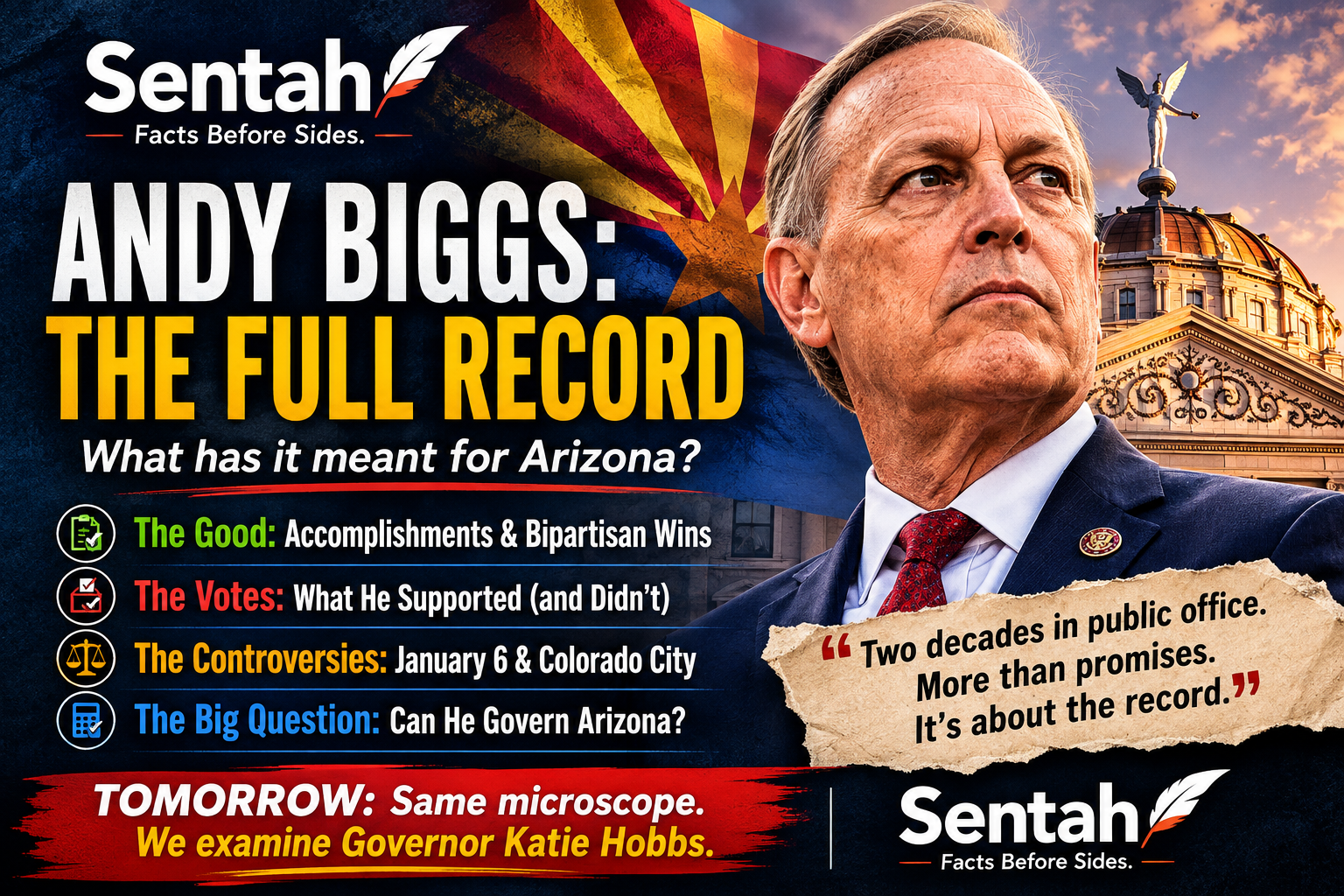
Andy Biggs is asking Arizona voters to make him governor.
That means voters do not have to judge him solely by what he promises to do next.
Biggs has spent more than two decades in elected office, beginning in the Arizona Legislature, eventually becoming president of the Arizona Senate, and later moving to Congress.
There are plenty of receipts.
And they do not tell a particularly simple story.
Biggs has accomplishments his supporters can legitimately point to. His congressional office has helped Arizona constituents recover millions of dollars while navigating federal agencies and benefits. He has backed government-accountability measures, supported efforts to strengthen Pentagon financial oversight and worked across party lines on some legislation despite a national reputation built largely around partisan battles.
His record also includes work involving issues with direct importance to Arizona, including water, mining and ranching.
Those things count.
So do the harder parts of the record.
Biggs voted against the final version of the PACT Act, which dramatically expanded health care and benefits for veterans exposed to burn pits and other toxic substances.
A vote like that deserves more than a political label.
Biggs and other opponents raised objections to aspects of the legislation and federal spending. Supporters argued that veterans suffering illnesses connected to their military service had waited far too long for comprehensive coverage.
The law ultimately passed.
For Arizona voters, the relevant question is not simply whether Biggs cast a conservative vote or whether Democrats supported the bill.
It is what the legislation did, why Biggs opposed it and what that decision meant for Arizona veterans.
That same standard should apply throughout his record.
Then there is January 6
Biggs’s actions following the 2020 presidential election cannot reasonably be separated from an examination of his public career.
On January 6, 2021, as Congress met to certify Joe Biden’s victory, Biggs objected to electoral votes. His office had announced objections involving Arizona and several other states.
Supporters of Biggs have characterized those actions as an effort to challenge election procedures they believed deserved greater scrutiny.
Critics see something much more serious: participation in an effort to reject certified election results after voters had already made their decision.
However voters interpret his reasoning, the underlying action is not speculation or campaign rhetoric.
It happened.
And someone seeking control of Arizona’s executive branch should expect voters to consider it.
The Colorado City question
Another controversy from Biggs’s years in the Arizona Legislature has followed him into the governor’s race: Colorado City and the FLDS.
In 2013, the Arizona House voted 52–7 for legislation intended to give the state greater authority to decertify law-enforcement agencies such as the Colorado City marshal’s office.
That overwhelming House vote matters.
The legislation then went to the Senate.
It never received a hearing.
Biggs was Senate president and opposed the bill.
Critics — including fellow Republicans — later accused him of helping bury the legislation. Biggs has defended his opposition by arguing that the proposal was overly broad and poorly written.
There is an important distinction here.
The available public record does not establish that Biggs personally ordered a committee chairman to kill the bill.
But neither should the episode be dismissed.
A bill passed the Arizona House 52–7, reached a Senate led by Biggs, and never received a hearing while the Senate president openly opposed it.
Questions about his role are fair.
Claims beyond what the evidence establishes are not.
Governing is different from voting
Perhaps the more important question now is what Andy Biggs’s record tells us about how he would govern.
A member of Congress can vote no.
A governor eventually has to say yes to something.
Arizona has a budget to balance, schools to fund, roads to maintain, prisons to operate, water supplies to protect and health and disability systems that tens of thousands of residents depend upon.
Biggs has proposed eliminating Arizona’s individual income tax.
For taxpayers, the appeal is obvious.
The harder question is what happens next.
Income-tax revenue represents a substantial piece of Arizona’s budget. If Biggs believes economic growth, expanded mining, reductions in fraud and a smaller state government can replace that revenue, voters deserve to see the numbers.
Which programs shrink?
Which revenues grow?
How quickly?
And what happens if the projected savings or economic growth do not materialize?
Those are not liberal questions.
They are not conservative questions.
They are math.
And governors have to make the math work.
A record long enough for everyone to cherry-pick
Andy Biggs has been in public office long enough that almost anyone can build the version of him they want.
Supporters can point to constituent service, conservative fiscal positions, government-accountability legislation, federal oversight efforts and a willingness to challenge institutions they believe have grown too powerful.
Opponents can point to January 6, controversial votes, Colorado City and policies they believe would weaken services or move Arizona too far toward the political right.
Both sides can cherry-pick.
The more useful exercise is putting the record on the same page.
What has Andy Biggs actually done for Arizona?
Some of it helped.
Some of it is debatable.
Some of it deserves harder questions.
And if he wants to be governor, all of it belongs in the conversation.
Tomorrow, we turn the same microscope on Governor Katie Hobbs.
Her accomplishments. Her failures. Her controversies. Her decisions — and what they have actually meant for Arizona.
Same questions. Same scrutiny. Same standard.
Facts before sides.