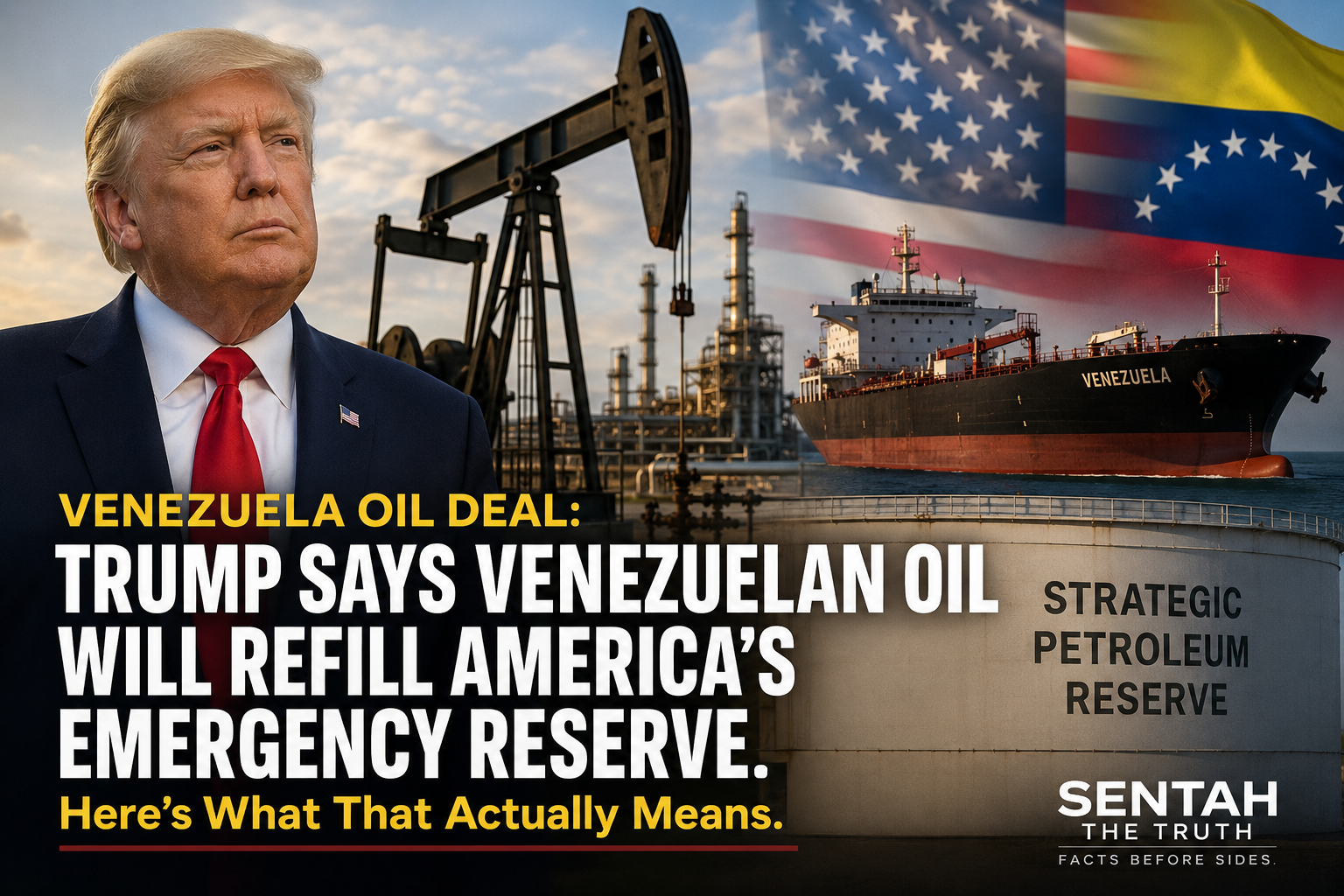
The announcement sounds simple: Venezuela has enormous oil reserves, the United States needs to rebuild its emergency supply, and Venezuelan crude could help do it.
The reality is more complicated.
Trump said Sunday that the process of refilling the reserve would begin soon. But exactly how quickly Venezuelan oil can reach the Strategic Petroleum Reserve — and whether the agreement will have any near-term effect on gasoline prices — remains unclear. Reuters reports that substantial investment and infrastructure work will be required before Venezuelan production can increase significantly.
What is the Strategic Petroleum Reserve?
The Strategic Petroleum Reserve, or SPR, is the federal government’s emergency crude-oil stockpile. It is stored in underground salt caverns along the Gulf Coast and is intended to help the country respond to major supply disruptions.
As of August 21, the reserve held about 290 million barrels of crude oil, roughly 41% of its total capacity and near its lowest level in 44 years.
The reserve has been drawn down under both the Biden and Trump administrations during periods of global disruption, including Russia’s invasion of Ukraine and the war involving Iran. Earlier this year, the Trump administration also lent tens of millions of barrels from the reserve to oil companies in an effort to stabilize supplies and prices during the Iran conflict.
That leaves Washington with a basic problem: the reserve serves little purpose in an emergency if it is never rebuilt afterward.
So what did the United States and Venezuela agree to?
The agreement announced over the past several days is much broader than simply buying some Venezuelan oil.
Venezuelan interim President Delcy Rodriguez says the energy agreement will last 25 years and initially targets development of 17 strategic oilfields, with a production goal of more than 1.5 million barrels per day under the bilateral arrangement. The broader plan also calls for development of eight additional oil blocks.
Trump has described the deal as giving the United States majority control over more than 65 billion barrels of Venezuela’s proven oil reserves through partnerships involving private companies. Venezuela, meanwhile, insists that it retains ownership and sovereignty over its natural resources.
Those two descriptions are not necessarily identical, and many of the precise legal and commercial details have not yet been publicly explained.
Before the agreement was announced, Reuters reported that negotiators were considering arrangements that would effectively lock in Venezuelan oilfields for development by American companies while guaranteeing resulting supplies to the United States. Reuters also reported that the structure could raise constitutional and legal questions inside Venezuela.
Why Venezuela?
Because Venezuela sits on an extraordinary amount of oil.
It has the world’s largest proven crude-oil reserves, but its actual production is far below what those reserves might suggest. Venezuela currently produces about 1.25 million barrels per day after years of underinvestment, deterioration, mismanagement and U.S. sanctions.
That distinction matters.
Having oil underground is not the same thing as having oil ready to put into a tanker.
Wells have to be restored or drilled. Pipelines, equipment and processing infrastructure may need repairs or expansion. Companies have to invest billions of dollars. Contracts and operating rights must be established. And Venezuela’s political and legal environment adds another layer of uncertainty.
That is why claims that this agreement will quickly produce dramatically cheaper gasoline deserve caution.
It could eventually increase supply.
That does not mean millions of additional barrels appear next week.
Will this lower gas prices?
Potentially — but there is no reliable basis yet for promising when or by how much.
Oil prices are determined by a global market. Venezuelan production is one component among many, including OPEC decisions, U.S. production, wars, sanctions, refinery capacity, shipping routes and global demand.
More Venezuelan crude entering the market could put downward pressure on oil prices over time, particularly if American companies succeed in restoring significant production.
But Reuters reports that it remains unclear how quickly the new deal could produce enough oil to benefit either the Strategic Petroleum Reserve or American motorists.
So the accurate version is:
The deal could eventually increase supply and help rebuild the reserve.
The unsupported version would be:
The deal is about to make gasoline cheap.
We do not have enough evidence for that conclusion yet.
There is also a political contradiction worth watching
The United States spent years imposing sanctions on Venezuela and trying to isolate its oil industry.
Now Washington is pursuing a long-term arrangement that could place American companies deeply inside that same industry.
That does not automatically mean the policy is wrong. Circumstances change, governments change and national interests change.
But it is a major shift, and one that deserves scrutiny beyond political slogans.
Venezuela says the agreement will help rebuild its economy and generate substantial government revenue. Rodriguez estimates the deal could generate about $209 billion for the Venezuelan state, although that projection assumes a benchmark oil price of $65 per barrel and depends on production targets actually being achieved.
The United States sees access to Venezuelan crude as a potential source of supply for American refineries, a way to strengthen energy security and now, according to Trump, a means of rebuilding the Strategic Petroleum Reserve.
Both governments have something substantial to gain.
What happens next matters more than the announcement
There are still unanswered questions.
How quickly can Venezuelan production actually increase?
How much oil will be directed to the Strategic Petroleum Reserve?
What will American companies pay, own or control?
What does “majority control” mean legally when Venezuela says it retains sovereignty over the oil?
How much investment will be required?
And ultimately, will the arrangement materially reduce American fuel costs?
Those answers will determine whether this becomes a major restructuring of the Western Hemisphere’s energy market — or another ambitious oil agreement whose promises take years to materialize.
For now, the verified facts are significant enough:
The United States and Venezuela have entered a long-term energy arrangement. Venezuela says it could last 25 years. Trump says Venezuelan oil will help refill an American emergency reserve sitting near a four-decade low.
What the agreement eventually delivers is something different from what either government says about it today.
Facts Before Sides.