Start with the part that is not spin
Katie Hobbs vetoes a lot of bills.
That is not merely a Republican talking point.
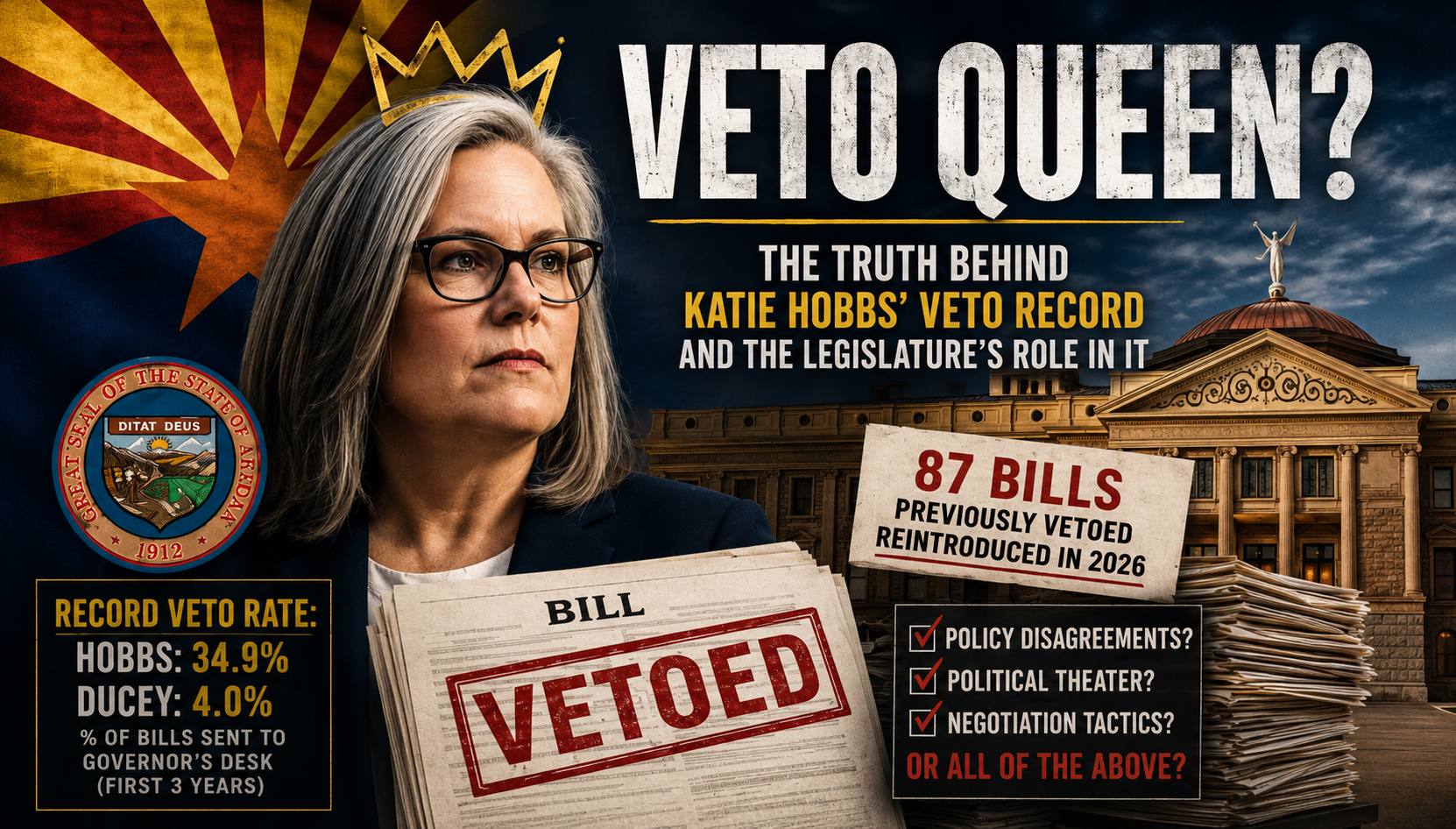
In 2023, Hobbs vetoed 143 of 348 bills sent to her — 41.1%. In 2024, she vetoed 73 of 332 — 22%. In 2025, she vetoed 174 of 439 — 39.6%. By the end of the 2026 session, she had vetoed another 151 bills, while signing 264.
Compare that with Republican Gov. Doug Ducey: over eight years, the Legislature sent him 2,745 bills and he vetoed 111 — roughly 4%.
So yes:
Hobbs’ veto rate is extraordinary.
The nickname “Veto Queen” did not appear out of thin air. It is now part of the political narrative surrounding her reelection campaign.
But raw totals leave out something important.
Arizona is governing under divided government
Hobbs is a Democratic governor.
Republicans control both chambers of the Arizona Legislature.
That means every significant bill has to survive two very different political filters before becoming law.
And in 2026, lawmakers introduced a record 2,116 measures.
Only about 21% reached Hobbs’ desk.
Of those, she signed 264 and vetoed 151.
That alone tells us something the “veto count” narrative sometimes misses:
She signs Republican-sponsored legislation too.
In fact, Republicans dominate the Legislature, so most bills that become law necessarily come through Republican-controlled chambers. In 2025, nearly everything Hobbs signed originated with Republicans because Democrats were able to move very little legislation through the Legislature.
So the question is not:
Does Hobbs veto Republicans?
Obviously she does.
The better question is:
Why are so many Republican bills reaching her desk when lawmakers already know she is likely to reject them?
That is where things get interesting.
⸻
Case Study #1: The foreign-land ban that Hobbs vetoed — then replaced with a broader one
In 2025, Republicans passed SB 1109, aimed at restricting foreign ownership of Arizona real estate.
By the time it reached Hobbs, the bill had been narrowed primarily to the People’s Republic of China.
It defined a “substantial interest” as at least 30% ownership and gave the attorney general enforcement authority.
Hobbs vetoed it.
Her formal veto message said the bill was ineffective at counterespionage, did not directly protect military assets, lacked clear implementation standards, and risked arbitrary enforcement.
Republicans could fairly describe that as another Hobbs veto of a conservative national-security bill.
But then something happened that complicates the narrative.
One week later, Hobbs proposed her own BAN Act — Blocking Adversarial Nations Act.
Her version expanded the concept beyond China to other foreign adversaries including Russia, Iran and North Korea, tightened protections surrounding military bases and critical infrastructure, and targeted proxies acting on behalf of foreign governments.
Then in July, Hobbs signed SB 1082, a bipartisan version of that broader approach, into law.
So what does that veto tell us?
That Hobbs opposed restricting hostile foreign governments from buying Arizona land?
No.
She ultimately signed a stronger restriction.
This veto looks much more like:
“I oppose this version of the policy.”
That distinction matters.
⸻
Case Study #2: HB 2970 — when the same bill comes back
Then there are vetoes where the Legislature makes Hobbs’ argument for her.
In June 2026, Hobbs vetoed HB 2970, dealing with jurisdiction over fraudulent schemes and artifices.
Her veto letter was unusually direct:
She said she had vetoed an almost identical bill in 2023, that the sponsor had made no attempt to resolve her concerns, and that the bill remained unnecessary and confusing.
That is not an isolated example.
Arizona Capitol Times found that lawmakers introduced 87 bills in 2026 that Hobbs had already vetoed in previous sessions.
Across her first three sessions, at least 50 of Hobbs’ 390 vetoes involved legislation that had previously been vetoed and then reintroduced.
In 2025 alone, at least 18 vetoed bills had been rejected by Hobbs before, most returning without substantial changes.
At some point, that raises an obvious question:
If the governor has already vetoed essentially the same bill and lawmakers make no meaningful change, what result are they expecting?
Perhaps they sincerely believe the policy is important enough to keep trying.
That is completely legitimate.
But politically, those repeat bills also produce something useful:
another veto.
⸻
Case Study #3: A digital currency that does not exist
Sometimes Hobbs’ veto explanations are much less elaborate.
Take SB 1095 from 2025.
The bill would have prohibited a federally recognized central bank digital currency from being used as legal tender or in various financial contracts in Arizona.
Hobbs vetoed it with essentially one argument:
A U.S. central bank digital currency did not exist.
Here, the ideological disagreement is genuine.
Supporters saw the bill as preventive protection against a future federal digital currency they believed could threaten privacy or financial freedom.
Hobbs viewed it as legislating against something hypothetical.
Neither interpretation requires political theater to explain the disagreement.
This is simply what divided government looks like:
One side says, prevent the problem before it exists.
The other says, do not create laws for hypothetical problems.
That veto belongs much more comfortably in the “real policy disagreement” column.
⸻
Case Study #4: Housing reform — veto the big bill, sign narrower reforms
Housing offers another useful example.
In 2024, Hobbs vetoed HB 2570, a sweeping zoning and home-design bill intended to reduce local restrictions and expand housing supply.
Her stated reason was not that Arizona did not need housing reform.
She said the proposal went too far.
The Department of Defense had warned that the legislation could weaken protections against incompatible development near military installations. Firefighters raised public-safety concerns. Hobbs also cited strong opposition from local officials and residents.
At the same time, she explicitly endorsed narrower reforms involving accessory dwelling units, “missing middle” housing, commercial-property conversions and streamlined approvals.
Again, that is harder to describe as:
Governor vetoes housing reform.
A more precise description is:
Governor vetoes one version of housing reform while supporting others.
That does not automatically make her judgment correct.
It does mean the veto count alone tells us very little about the substance.
⸻
Case Study #5: The rental-tax fight
In 2023, Republicans tried to eliminate municipal taxes on residential rentals through SB 1184.
Hobbs vetoed it.
Her reasoning was specific: there was no enforceable mechanism ensuring landlords would actually pass the tax savings to renters, and she argued the measure risked becoming primarily a landlord tax cut while reducing municipal revenue.
Republicans saw the repeal as straightforward tax relief.
Hobbs argued that without an enforceable pass-through, renters might never see the promised benefit.
That is exactly the kind of veto Sentah should examine rather than merely count.
Was she protecting renters?
Was she protecting municipal revenue?
Was the Legislature correct that eliminating the tax would lower housing costs?
Those are factual questions.
The word VETO does not answer any of them.
⸻
Then came the veto moratorium
There is another category of veto that cannot honestly be described as purely bill-by-bill policy analysis.
On April 13, 2026, Hobbs announced that she would veto all bills sent to her until Republican legislative leaders publicly produced their budget proposal and entered what she considered serious budget negotiations.
She carved out only limited public-safety exceptions.
That was unmistakably a negotiating tactic.
Whatever one thinks of it, it means some vetoes during that period reflected a broader political strategy rather than only objections to the individual legislation.
Republicans could reasonably point to that and say:
See? The veto pen is being used as leverage.
They would be right.
But Republicans were also using legislation as leverage.
That is the part both sides tend to omit from their own version of the story.
⸻
Were Republicans deliberately running up her veto total?
We cannot prove every lawmaker’s motive.
And it would be irresponsible to claim that every doomed bill was introduced merely to manufacture a campaign statistic.
Legislators are elected to advance policies they believe in.
A Republican lawmaker does not suddenly stop believing in election restrictions, gun legislation, tax cuts or groundwater policy simply because a Democratic governor is likely to veto it.
There is value in putting lawmakers on record.
There is value in putting a governor on record too.
But there is also evidence that Republican leaders knew many measures were headed directly for the veto stamp.
In 2025, Hobbs accused Republicans of an orchestrated effort to “run up the score” on her veto record.
Arizona Capitol Times found that even after excluding 28 budget bills from two House budget packages she rejected, Hobbs still would have broken her previous single-session veto record — although only narrowly.
And in 2026, the pattern intensified: 87 previously vetoed proposals came back again.
Arizona Agenda described a May budget vote as a situation in which Republicans knew Hobbs would reject their proposal, passed it anyway, and gained something politically useful in return: a record of their priorities and a governor to blame for rejecting them.
That does not prove conspiracy.
It does show that vetoes themselves have political value.
⸻
The “small government” contradiction
This also raises an uncomfortable question for Arizona Republicans.
The Republican Party traditionally presents itself as the party of:
smaller government, fewer regulations and fewer unnecessary laws.
Yet Arizona lawmakers introduced a record 2,116 measures in 2026.
Not all of those were Republican bills.
Not every bill creates a new regulation.
Many modify, repeal or streamline existing laws.
So raw bill volume alone does not prove hypocrisy.
But record legislative output deserves scrutiny from a political movement that regularly criticizes government overreach.
And if dozens of those measures are nearly identical to legislation the same governor already vetoed, the question becomes even sharper:
How much of the Legislature’s work is intended to create law — and how much is intended to create political contrast?
⸻
So who owns the veto record?
Both sides.
Katie Hobbs owns every veto she signs.
She has unquestionably used the veto more aggressively than Arizona’s recent Republican governor.
At times she has used it strategically rather than purely on the merits of individual bills.
Republicans are entitled to make that part of their case against her.
But Arizona’s Republican Legislature also owns the pipeline feeding her desk.
It has repeatedly revived bills she already rejected.
It has passed legislation with little or no bipartisan support knowing the governor opposed it.
And at times, legislators have gained politically from the very vetoes they publicly condemn.
So when voters hear:
“Katie Hobbs vetoed 541 bills.”
The number is true.
But numbers require context.
A veto can represent ideological obstruction.
It can represent a legitimate policy objection.
It can represent failed negotiation.
It can represent political leverage.
And sometimes it can represent a Legislature intentionally forcing a governor to choose between signing something she opposes and handing them another campaign talking point.
The nickname “Veto Queen” is catchy.
The reality underneath it is considerably more complicated.
The better question
Not:
How many bills did Katie Hobbs veto?
But:
What were those bills, why did she veto them, and why did lawmakers send them to her in the first place?
That is where the story actually begins.
Facts before sides.