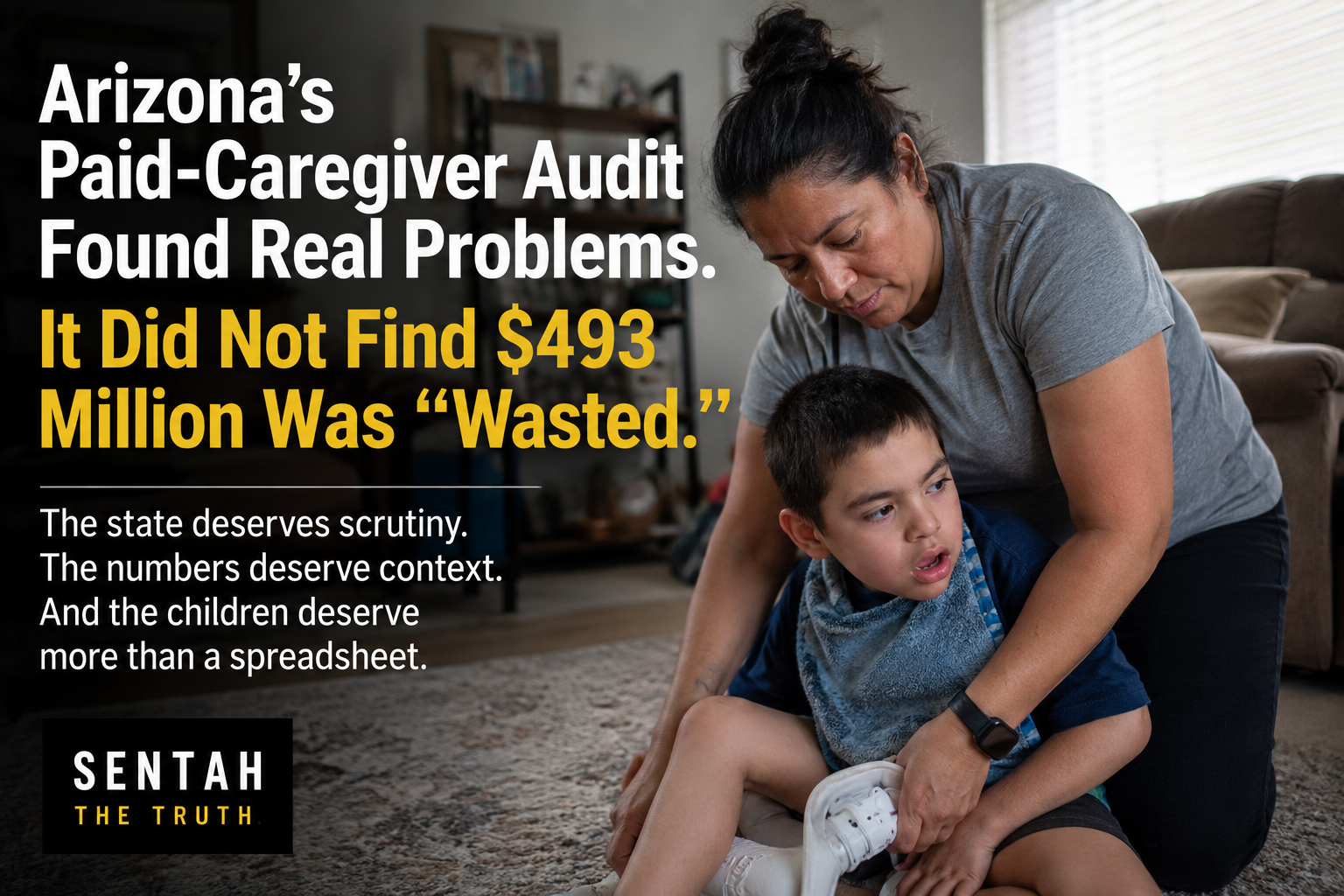
The state deserves scrutiny. So does the way the audit is being reported.
Arizona’s system that pays parents to provide extraordinary care for their children with developmental disabilities has a problem.
Actually, it has several.
The Arizona Auditor General found that state agencies failed to fully implement cost-control requirements enacted by lawmakers in 2025. AHCCCS did not implement a required standardized assessment tool by the deadline, and enforcement of a 40-hour limit on parent-provided paid care did not begin until April 2026.
Those are legitimate findings.
Arizona taxpayers deserve accountability. State agencies should follow the law. Fraud, improper payments and inadequate oversight should be identified and corrected.
But accountability also requires accuracy.
And that is where some of the reporting surrounding this audit has gone off the rails.
One Arizona outlet characterized the findings as suggesting that nearly half a billion dollars may have been “wasted.”
That is not what the audit found.
The actual finding was that suspending the standardized assessment tool meant the state did not realize an estimated $133 million to $493 million in potential cost reductions during fiscal year 2026.
Read those words carefully:
Potential cost reductions.
That is not synonymous with waste.
It is not a finding of $493 million in fraud.
It is not a finding that parents improperly received $493 million.
And it is not evidence that Arizona wrote nearly half a billion dollars in checks for care that children did not need.
There is a profound difference between identifying money that potentially could have been saved by reducing authorized services and establishing that the money actually spent was wasteful.
That distinction becomes even more important when we stop talking about spreadsheets and start talking about what those dollars purchase.
What happens to the care?
The 40-hour rule is another place where context matters.
Arizona’s law places limits on the number of paid care hours a parent can provide. But when a child is medically assessed as requiring additional authorized services, limiting the parent’s paid hours does not necessarily eliminate the child’s need for those services.
Someone else has to provide them.
That sounds simple on paper.
Find another caregiver.
For families living inside Arizona’s developmental-disability system, however, there is an enormous difference between an authorized caregiver and an available caregiver.
A name on a service plan does not walk through the front door.
An authorization does not give a child a bath.
It does not help someone use the toilet.
It does not prepare food for a child with complicated feeding needs.
It does not redirect self-injurious behavior.
It does not stop a child from eloping out the front door.
It does not monitor a seizure.
A human being does those things.
And when there isn’t another human being available, the need doesn’t disappear.
The parent does it anyway.
That is the human reality missing from much of this debate.
These are not payments for ordinary parenting
It is easy to hear “parents being paid to care for their children” and imagine the government paying someone to perform the ordinary responsibilities every parent has.
That is not an accurate description of the population at the center of this debate.
These services exist for children whose disabilities can require extraordinary levels of care.
Some require assistance with virtually every activity of daily living. Some require constant supervision because they cannot recognize danger. Some have significant communication disabilities. Others may experience seizures, self-injurious behavior, aggressive behavior, feeding difficulties, mobility limitations or elopement.
Their parents don’t clock out when the authorized hours run out.
The disability doesn’t clock out either.
That is why the question policymakers should ask isn’t merely:
How much can we reduce spending?
It is also:
Who provides the care after we reduce it?
If Arizona has qualified workers ready to replace those hours, that is one thing.
If those workers do not exist, the state hasn’t eliminated the need.
It has transferred responsibility for meeting it.
Usually back onto the family.
There is a reason America moved away from institutions
This isn’t theoretical.
For generations, when society did not adequately support people with significant disabilities in their homes and communities, America had another answer:
Institutions.
Willowbrook State School became perhaps the most notorious example.
Thousands of people with intellectual and developmental disabilities lived there under conditions that eventually shocked the country. Overcrowding, neglect, degrading living conditions and abuse helped expose what could happen when vulnerable people were segregated from their families and communities and made almost completely dependent upon institutions for their survival.
We should be careful not to suggest that every residential facility today is Willowbrook.
That would be false and unfair.
But we should be equally careful about forgetting why the disability-rights movement fought so hard for community-based care.
The danger to people with disabilities is not merely historical.
A large updated systematic review covering 98 studies and more than 16.8 million children estimated that 31.7% of children with disabilities had experienced some form of violence and found that they faced roughly twice the odds of violence compared with children without disabilities.
Research specifically examining sexual violence has likewise found substantially elevated risk. An earlier systematic review estimated children with disabilities had approximately 2.9 times the odds of sexual violence compared with children without disabilities.
A more recent systematic review identifies precisely the vulnerabilities disability families worry about: dependence on other people for care, social isolation, restrictive environments, unequal power relationships and communication difficulties. It also notes that segregation and institutionalization can increase vulnerability to sexual victimization, particularly among children with intellectual and communication disabilities.
Those statistics are not an argument that every institution or group home is abusive.
They are an argument for taking the consequences of disability policy seriously.
Because when home- and community-based supports fail, the person receiving those services doesn’t suddenly become less disabled.
The need goes somewhere.
It goes to an unpaid and exhausted parent.
It goes to another family member.
It can show up in emergency rooms and hospitals.
And for some people with the most significant needs, loss of adequate community support can ultimately increase pressure toward more restrictive settings.
That history should matter whenever Arizona talks about “cost reduction.”
The audit still matters
None of this means the Auditor General should be dismissed.
Quite the opposite.
The audit found that AHCCCS and DES had not fully implemented all of the cost-control requirements required under the 2025 law.
That deserves investigation.
The state needs reliable assessments.
It needs accurate records.
It needs mechanisms capable of detecting improper billing.
It needs to know whether authorized services are actually being provided.
And when state law requires an agency to do something, the agency cannot simply pretend the requirement doesn’t exist.
AHCCCS and DES have also disputed portions of the Auditor General’s conclusions and offered explanations that deserve examination. AHCCCS has pointed to federal Medicaid requirements, litigation risk, operational demands and implementation timelines. DES has cited steps it says were already underway to improve compliance and oversight. And any serious examination of the program also has to account for access to care: limiting who may provide authorized services does not guarantee that another qualified worker is actually available to provide them.
Good journalism doesn’t decide which side of a disagreement the reader is allowed to hear.
The answer is not to minimize the audit.
The answer is to report what it actually says.
Words matter
There is a significant difference between:
The state failed to implement required cost controls.
and:
The state wasted nearly $500 million.
There is a difference between:
Auditors estimated $133 million to $493 million in potential cost reductions.
and:
Parents received nearly $500 million they shouldn’t have received.
And there is an enormous difference between:
reducing fraud
and
reducing medically necessary care.
Those concepts should never be casually collapsed into one another.
Arizona should investigate fraud wherever it exists.
Arizona should recover improper payments.
Arizona should demand accountability from agencies entrusted with billions of taxpayer dollars.
And Arizona should absolutely ask whether every dollar spent through its developmental-disability system is being spent appropriately.
But there is one more question that belongs in that conversation:
What happens to the child?
When an assessment reduces someone’s authorized hours, who provides the care that disappears?
When a parent reaches 40 hours, is another qualified worker actually available to take over?
When policymakers calculate hundreds of millions of dollars in potential savings, how much represents genuine efficiency — and how much represents care that someone will still have to provide without being paid?
Those aren’t emotional distractions from the fiscal question.
They are part of the fiscal question.
Because a child’s seizure doesn’t disappear when an appropriation runs out.
Autism doesn’t follow the state budget.
A person who needs help bathing still needs help bathing.
And someone who requires around-the-clock supervision still requires supervision after the spreadsheet reaches zero.
Arizona’s taxpayers deserve accountability.
Arizona’s disability community deserves accountability too.
We can demand both.
But if we’re going to have that debate, we should at least begin with the truth:
Potential savings are not automatically waste.
And behind every number being debated at the Capitol is a human being whose needs don’t disappear simply because Arizona would prefer the number to be smaller.