Start with what this does NOT mean
Your faucet isn’t about to stop working.
Phoenix residents aren’t being ordered to ration water.
And Arizona isn’t suddenly becoming uninhabitable.
Those are important facts because a number like 760,000 acre-feet sounds catastrophic without context.
But the opposite extreme isn’t accurate either.
This is a serious change to one of Arizona’s most important water supplies.
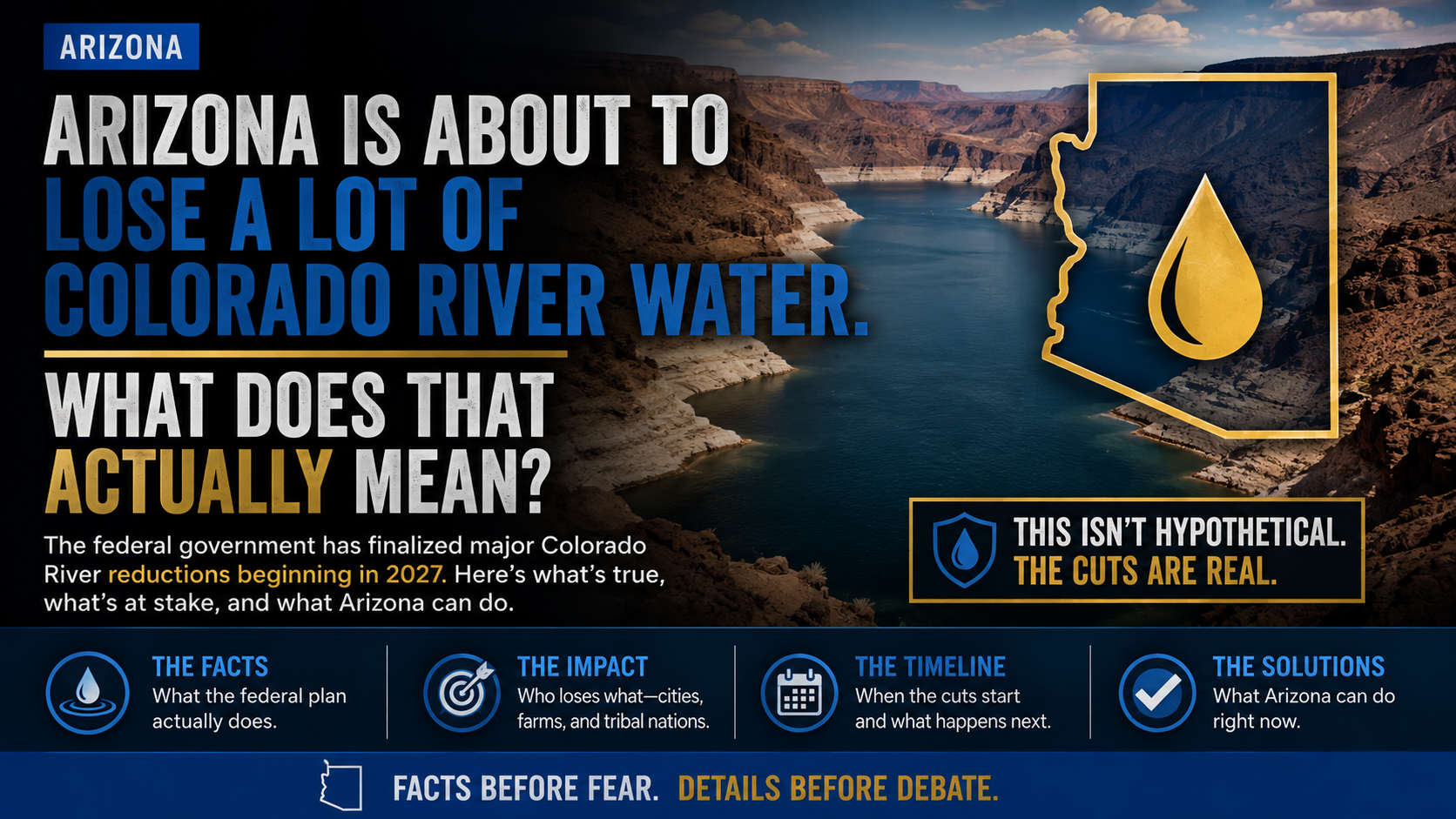
On August 21, the U.S. Department of the Interior finalized new operating guidelines for the Colorado River beginning in 2027. The Lower Basin states—Arizona, California and Nevada—must reduce their combined deliveries by 1.25 million acre-feet in both 2027 and 2028.
Under the three states’ proposed sharing agreement, that breaks down to:
Arizona: 760,000 acre-feet
California: 440,000 acre-feet
Nevada: 50,000 acre-feet
The Lower Basin states are also expected to voluntarily conserve and store at least another 700,000 acre-feet over the two-year period.
That’s real water.
And Arizona gets the largest numerical reduction.
Why is this happening?
The Colorado River has a math problem.
For decades, governments built cities, farms and economies around expectations of how much water the river could reliably provide.
The river hasn’t cooperated.
The Colorado River Basin has experienced a multidecadal drought, and conditions deteriorated sharply in 2026. According to the Interior Department, the winter of 2025–26 produced the lowest observed snowpack on record.
Lake Mead and Lake Powell recently reached historically low levels.
Those reservoirs aren’t merely giant lakes.
They’re the storage system that allows much of the Southwest to function.
And the federal government is now trying to prevent that system from falling into even more dangerous territory.
So is Phoenix running out of water?
No.
That’s not our interpretation.
That’s what the City of Phoenix itself says.
The federal decision does not immediately interrupt water service or impose mandatory restrictions on Phoenix customers.
There’s an important reason.
Phoenix doesn’t get all its water from the Colorado River.
Approximately 40% of Phoenix’s current drinking-water supply comes from the Colorado River through the Central Arizona Project.
About 58% comes from the Salt and Verde rivers, with roughly 2% coming from groundwater.
Phoenix has also spent decades preparing for shortages.
The city says it has stored approximately 700,000 acre-feet underground in the Phoenix and Tucson areas and maintains groundwater wells that can help recover stored supplies when necessary.
There’s another remarkable number.
Despite enormous population growth, Phoenix says it uses roughly the same total amount of water today as it did 30 years ago, while per-person consumption has continued declining.
That’s part of the story that gets lost when Arizona water discussions become apocalyptic.
Arizona has a serious problem.
Arizona has also been preparing for it.
Both things can be true.
But somebody has to absorb the cuts
This is where the argument gets much more complicated.
The Colorado River serves seven U.S. states.
Arizona, California and Nevada make up the Lower Basin.
Colorado, Utah, Wyoming and New Mexico make up the Upper Basin.
The new federal framework places mandatory reductions on the Lower Basin states while imposing no comparable mandatory reductions on the four Upper Basin states.
Upper Basin states argue that drought and declining river flows already reduce the amount of water physically available to them.
Lower Basin states argue that everyone depending on the same shrinking river should share mandatory reductions.
That’s the fight underneath the headlines.
Arizona isn’t happy about it
Arizona officials have argued that the state is being asked to shoulder a disproportionate burden.
Governor Katie Hobbs welcomed the near-term approach for 2027 and 2028 but criticized the failure to require reductions from the Upper Basin and said Arizona remains prepared to protect its water rights.
Phoenix officials have made essentially the same argument: the city can handle the immediate reduction, but the long-term solution needs participation across the entire basin.
And Arizona isn’t alone.
Nevada filed a federal lawsuit Monday challenging the new federal plan, arguing among other things that the government failed to adequately consider alternatives and economic consequences.
So this fight isn’t finished.
Agriculture matters—a lot
When people hear “Arizona water,” they understandably think about showers, swimming pools and lawns.
But Colorado River water isn’t only drinking water.
It supports agriculture, tribal communities, industry and cities throughout the Southwest.
Nationally, the river supports millions of acres of farmland and ranchland. The Interior Department says more than 40 million people depend on the Colorado River system.
That means the consequences of a shrinking river don’t stop at a municipal water meter.
Water affects food production.
Development.
Housing.
Industry.
Energy.
Tribal water rights.
And eventually, prices.
The bigger question starts after 2028
The 2027 and 2028 reductions are substantial.
But they’re also the relatively predictable part of the story.
The federal government has established a broader framework extending through 2036, with operating decisions revisited as conditions evolve.
And future reductions could become considerably larger if reservoir conditions continue deteriorating.
That’s why the argument among the seven states matters so much.
They’re not merely negotiating who gives up water next year.
They’re negotiating how the American Southwest operates with a river that may provide less water than the region built itself around.
So should Arizonans panic?
No.
Should they pay attention?
Absolutely.
Phoenix has diversified supplies, stored water underground, invested in infrastructure and dramatically reduced per-person consumption.
That buys resilience.
It doesn’t manufacture water.
The Colorado River is smaller than the system built around it expected it to be, and eventually the numbers have to balance.
The real debate isn’t whether Arizona runs out of water tomorrow.
It doesn’t.
The question is harder:
How does Arizona continue growing while using less Colorado River water—and who should bear the cost of making that possible?
That’s the conversation worth having.
Not panic.
Not denial.
Facts before sides.