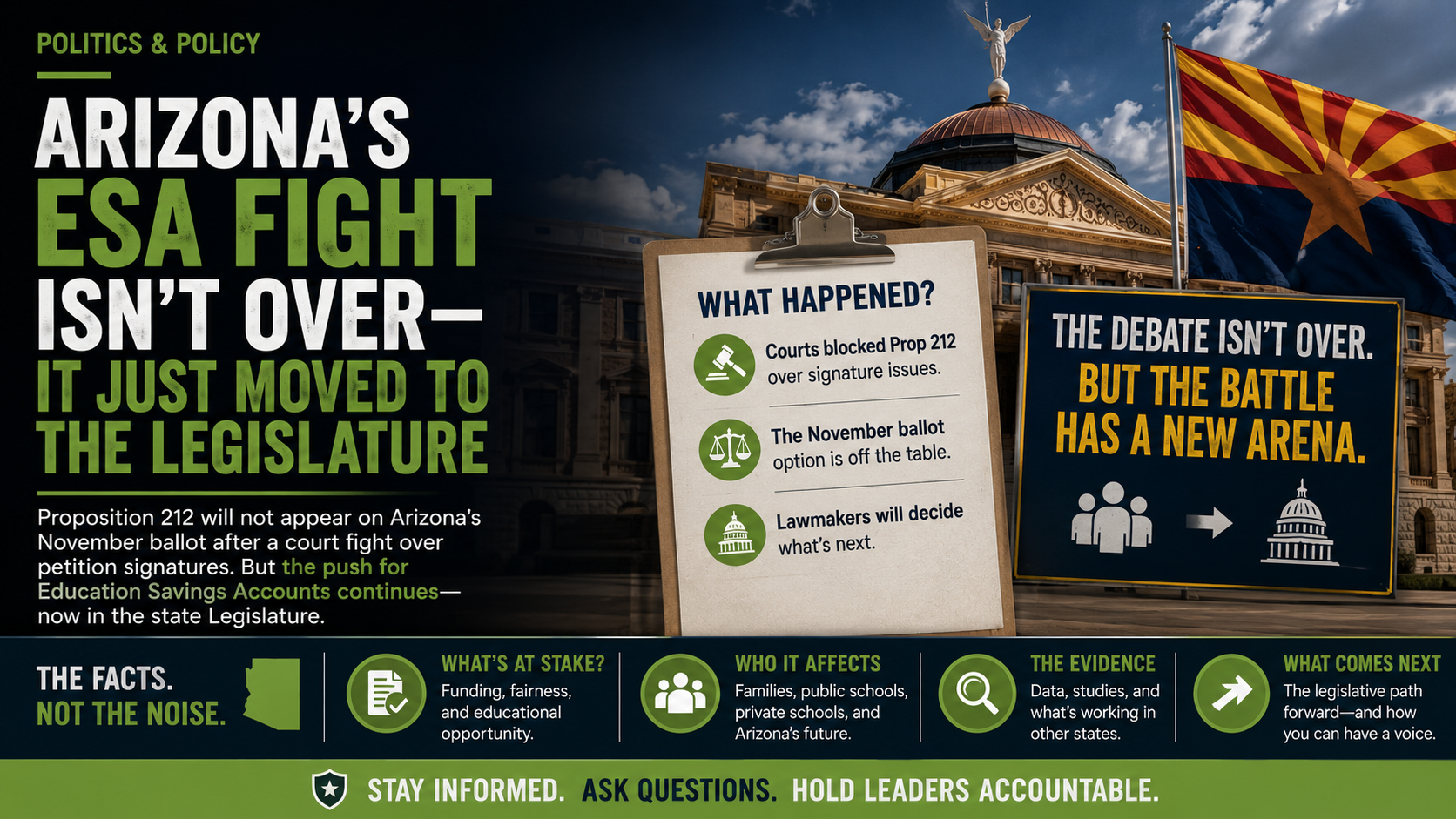
Arizona voters were supposed to have a major decision to make
For months, Arizona appeared headed toward another statewide showdown over Empowerment Scholarship Accounts.
Proposition 212, known as the Protect Education Act, sought sweeping changes to Arizona’s universal ESA program.
Supporters submitted more than 420,000 petition signatures in an attempt to put the measure before voters in November.
It won’t get there.
On August 18, the Arizona Supreme Court rejected the measure’s remaining legal argument after a court challenge resulted in enough petition signatures being disqualified to push the initiative below the required threshold.
That means Arizona voters will not decide Proposition 212 this November.
But anyone interpreting that as the end of Arizona’s ESA fight is missing what comes next.
The battlefield is shifting from the ballot box to the Legislature.
What would Proposition 212 have done?
The proposal would have substantially changed who could participate in Arizona’s ESA program and how ESA money could be spent.
Beginning in the 2027–28 school year, the measure would generally have limited new ESA participation to families earning no more than $150,000 annually, adjusted over time.
Importantly, that income restriction would not have applied to several groups eligible for ESAs before universal expansion—including children with disabilities.
The proposal also included additional accountability and spending provisions, including restrictions aimed at luxury purchases, background-check requirements for certain educators and service providers, academic requirements, and provisions governing unused ESA funds.
Supporters described those changes as necessary accountability for a rapidly expanded taxpayer-funded program.
ESA supporters saw something very different: restrictions on a school-choice program now used by roughly 100,000 Arizona students and families.
There actually was room for compromise
One part of this story gets lost in the political shouting.
Arizona lawmakers, education groups and school-choice advocates did negotiate ESA reforms during the 2026 legislative session.
Republican lawmakers offered provisions addressing luxury purchases, background checks and fingerprinting, unused balances and additional staffing at the Arizona Department of Education.
Negotiations ultimately broke down.
That matters because the ESA debate isn’t simply:
Regulation versus no regulation.
There has already been recognition across political lines that a billion-dollar public program can have accountability rules while continuing to exist.
The real disagreement is over how far those rules should go—and whether universal eligibility itself should survive.
Then the courts changed everything
Proposition 212 needed 255,949 valid signatures to qualify as a statutory initiative under Arizona’s 2026 requirements.
Its supporters submitted far more than that.
But submitting signatures and having valid signatures are different things.
Following challenges and county verification, enough signatures were disqualified that supporters fell below the legal threshold.
The Arizona Supreme Court ultimately rejected the argument that signatures had effectively been improperly counted against the initiative twice.
The result was straightforward:
Prop. 212 was off the ballot.
So what happens now?
This is where the story becomes much bigger than Proposition 212.
One of the organizations behind the ESA reform movement, Save Our Schools Arizona, is also openly engaged in Arizona legislative politics.
Its own political fundraising materials state that its efforts include:
* flipping the Arizona Legislature,
* electing public-education candidates,
* fully funding public schools, and
* stopping what it describes as harmful and unaccountable universal vouchers.
That makes the November legislative elections enormously consequential for ESA policy.
A ballot initiative requires hundreds of thousands of valid voter signatures and must survive legal challenges before voters ever see it.
A Legislature passes laws.
If political control of the Arizona House and Senate changes, the path toward changing ESA law changes with it.
And that’s the fight voters should understand
The debate over Arizona ESAs is frequently reduced to slogans.
One side talks about school choice and parental freedom.
The other talks about **privatization and taxpayer accountability
Both describe real parts of the argument. Neither tells voters enough.
ESA families—including families with children with disabilities—can use the program to obtain educational environments and services they believe better fit their children’s needs.
At the same time, the program spends public money, creating legitimate questions about oversight, fraud prevention, eligible expenses and accountability.
Those ideas don’t have to be mutually exclusive.
Arizona can debate universal eligibility, income limits, testing requirements, appropriate purchases and safeguards against fraud.
But voters should know exactly what lawmakers are proposing and who would be affected.
The disability question deserves particular attention
Children with disabilities were eligible for Arizona’s ESA program long before universal eligibility.
Prop. 212 itself recognized that distinction by exempting previously eligible groups—including qualifying students with disabilities—from its proposed $150,000 income limit.
That distinction shouldn’t disappear simply because Proposition 212 disappeared from the ballot.
Future legislation could be narrower than Prop. 212. It could be broader. It could preserve protections for disability families—or a future Legislature could write something entirely different.
That’s why ESA voters should pay attention not only to candidates saying “public education” or “school choice,” but to what those candidates would actually vote to put into Arizona law.
The real November ESA vote
Arizona voters won’t vote on Proposition 212.
But in another sense, they may still be voting on the future of ESAs.
Save Our Schools Arizona has made legislative control part of its strategy. ESA advocates will likewise fight to elect lawmakers who will protect the program.
November could therefore determine whether Arizona’s next Legislature expands, preserves, regulates or restricts ESAs.
The initiative is dead.
The policy fight isn’t.
And this time, the names voters should be watching aren’t just the names of propositions.
They’re the names of the people running for the Arizona Legislature.
Facts before sides.