Start with something everyone should agree on
If someone is stealing Medicaid money, investigate it.
If a provider bills for services that were never delivered, prosecute it.
If a state is submitting improper claims to the federal government, taxpayers deserve to know.
None of that should be controversial.
But neither should this:
Government should establish that money was improperly spent before treating an entire category of care as though its growth proves fraud.
That’s where the current Medicaid fight gets complicated.
What did the federal government actually do?
On July 21, the U.S. Department of Health and Human Services announced that it was deferring more than $1 billion in Medicaid payments to California and Minnesota while demanding additional documentation for claims it considers high-risk.
HHS said the action was intended to combat fraud, waste and abuse and specifically identified concerns involving personal-care and home-and-community-based services.
Importantly, a deferral isn’t necessarily a final determination that the claims were fraudulent.
It’s the federal government saying: prove these claims are legitimate before we reimburse them.
Additional reimbursement disputes have pushed the amounts at issue considerably higher, with California facing roughly $2.2 billion in withheld reimbursements and Minnesota about $550 million as of early August.
Why is home care getting attention?
Federal officials have questioned the rapid growth of spending on in-home services.
HHS Secretary Robert F. Kennedy Jr. said the government suspects much of the questionable spending involves in-home care.
CMS Administrator Mehmet Oz has also argued that these programs can be abused.
That’s a legitimate possibility.
Any system involving billions of dollars can attract fraud.
But spending growth isn’t itself proof of fraud.
Several other things can increase spending:
More people receiving services.
More hours of care.
Higher wages for direct-care workers.
An aging population.
More people choosing community care instead of nursing facilities and institutions.
Greater recognition that people with significant disabilities can live in their communities when adequate support exists.
Those possibilities don’t disprove fraud either.
They demonstrate why the underlying claims have to be examined rather than inferred from a spending graph.
What exactly is HCBS?
This acronym matters.
HCBS means Home and Community-Based Services.
Medicaid uses several programs and waiver authorities to provide long-term services to people in their homes and communities rather than institutional settings.
Services can include personal care, habilitation, respite, case management, home-health assistance, supported employment and other supports.
These aren’t simply conveniences.
For some people with significant disabilities, they’re what makes living at home possible.
And this isn’t some obscure corner of Medicaid.
CMS reports that 86.2% of Medicaid long-term-services-and-supports users received HCBS in 2021, while 63.2% of Medicaid LTSS expenditures went toward HCBS.
America has spent decades moving long-term care toward the community.
There’s a reason for that
Historically, many people with significant disabilities had few alternatives to institutionalization.
Medicaid’s HCBS waiver system was specifically designed to change that.
Federal rules allow states to provide services to people who otherwise might qualify for care in an institutional setting.
In fact, states operating 1915(c) HCBS waivers must demonstrate that providing those waiver services will not cost more than providing institutional care.
That matters in this debate.
Home care isn’t merely another government benefit competing with institutional care.
It is part of the government’s long-running strategy for providing an alternative to institutionalization.
There’s also a civil-rights issue
In 1999, the Supreme Court’s landmark Olmstead v. L.C. decision established that unjustified segregation of people with disabilities can violate the Americans with Disabilities Act.
Federal enforcement of the ADA’s integration mandate has consequently emphasized services that allow disabled people to live in integrated community settings.
The Justice Department specifically identifies HCBS waivers, personal-care services, respite, supported housing, case management and supported employment among tools that can help accomplish that.
That’s why changes to home-care funding deserve scrutiny beyond a simple budget debate.
The alternative for some people isn’t:
government-funded caregiver versus no caregiver.
It can eventually become:
community-based support versus institutional care.
But fraud is real
This is where both sides need to resist oversimplification.
Disability advocates shouldn’t respond to every fraud investigation as though oversight itself threatens disabled people.
Taxpayer-funded programs require oversight.
CMS already requires states to maintain safeguards, quality monitoring, provider standards and systems designed to protect beneficiaries.
Recent federal Medicaid rules have actually strengthened requirements involving incident management, grievances, service planning and reporting on how much certain HCBS payments reach direct-care workers.
Those safeguards exist for good reason.
Fraud doesn’t merely hurt taxpayers.
It takes resources away from the people Medicaid is supposed to serve.
But allegations aren’t findings
That’s the other half of the equation.
The federal government’s July announcement describes the claims as high-risk and says states must provide additional documentation.
That’s different from announcing that investigators uncovered $1 billion in proven fraud.
And that distinction matters.
If an investigation ultimately demonstrates widespread improper billing, publish the evidence.
Recover the money.
Fix the vulnerabilities.
Prosecute intentional fraud where appropriate.
But if the evidence doesn’t establish fraud on anything approaching the scale implied by the withheld reimbursements, that matters too.
Accountability works both directions.
Who carries the risk while Washington and the states fight?
This may be the most important question.
California and Minnesota have continued paying for Medicaid services while federal reimbursement is disputed, meaning the immediate financial burden falls largely on state governments.
But states don’t have unlimited money.
A prolonged reimbursement fight can eventually create pressure somewhere else in the system.
And behind every budget line are actual services.
A worker helping someone shower.
A parent providing authorized care to a profoundly disabled adult child.
A direct-support professional helping someone prepare meals.
Respite that allows a caregiver to sleep.
Transportation.
Habilitation.
Help getting into bed.
Help getting out of bed.
These services aren’t particularly dramatic until they’re gone.
Then they become everything.
There’s a reasonable middle position here
Medicaid fraud shouldn’t be tolerated.
Neither should weak oversight.
Neither should treating legitimate scrutiny as inherently anti-disability.
But protecting taxpayers and protecting disabled people aren’t competing objectives.
A functioning system should be able to do both.
Audit aggressively.
Require documentation.
Recover improper payments.
Prosecute actual fraud.
And simultaneously:
Protect legitimate services while the investigation occurs.
Because the purpose of detecting Medicaid fraud should be to preserve Medicaid resources for people who legitimately need them—not destabilize the services those people rely upon.
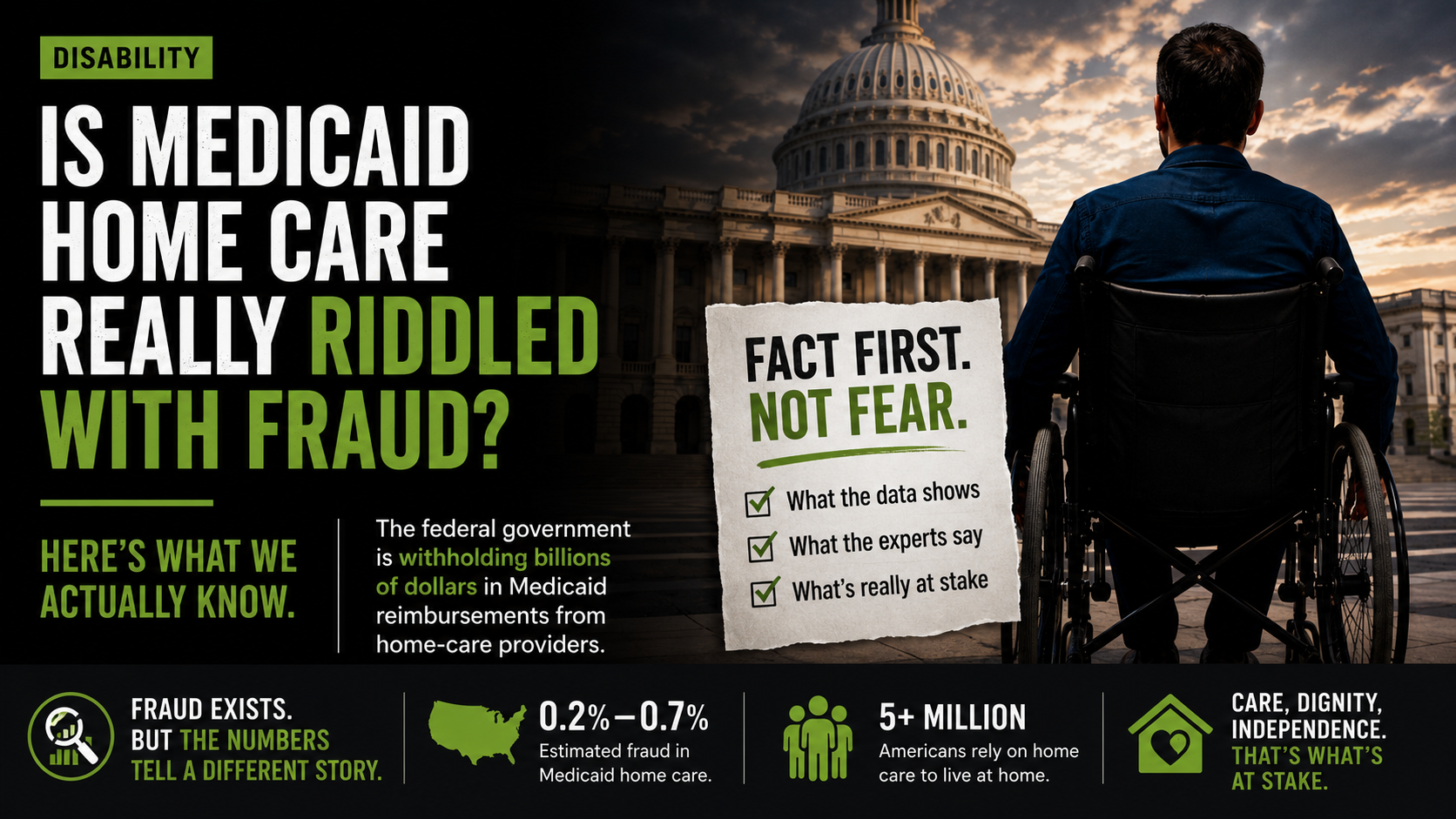
So is Medicaid home care riddled with fraud?
Based on the evidence publicly presented so far, we can’t responsibly say that.
The federal government has identified claims it considers high-risk and has demanded documentation. That’s significant and deserves investigation.
But a payment deferral isn’t a fraud conviction.
Rapid spending growth isn’t proof of fraud.
And defending home-based care doesn’t require pretending fraud never happens.
The answer should depend on what the evidence ultimately shows.
That’s the point.
Investigate the claims.
Publish the evidence.
Follow it wherever it leads.
Disabled people deserve accountability too—both from the people spending Medicaid dollars and from the government responsible for protecting the services they depend on.
Facts before sides.