There is a strange assumption built into American politics:
If you refuse to join one side completely, you must be “in the middle.”
And if you are in the middle, you must be weak, indecisive, or unwilling to take a stand.
I don’t buy that.
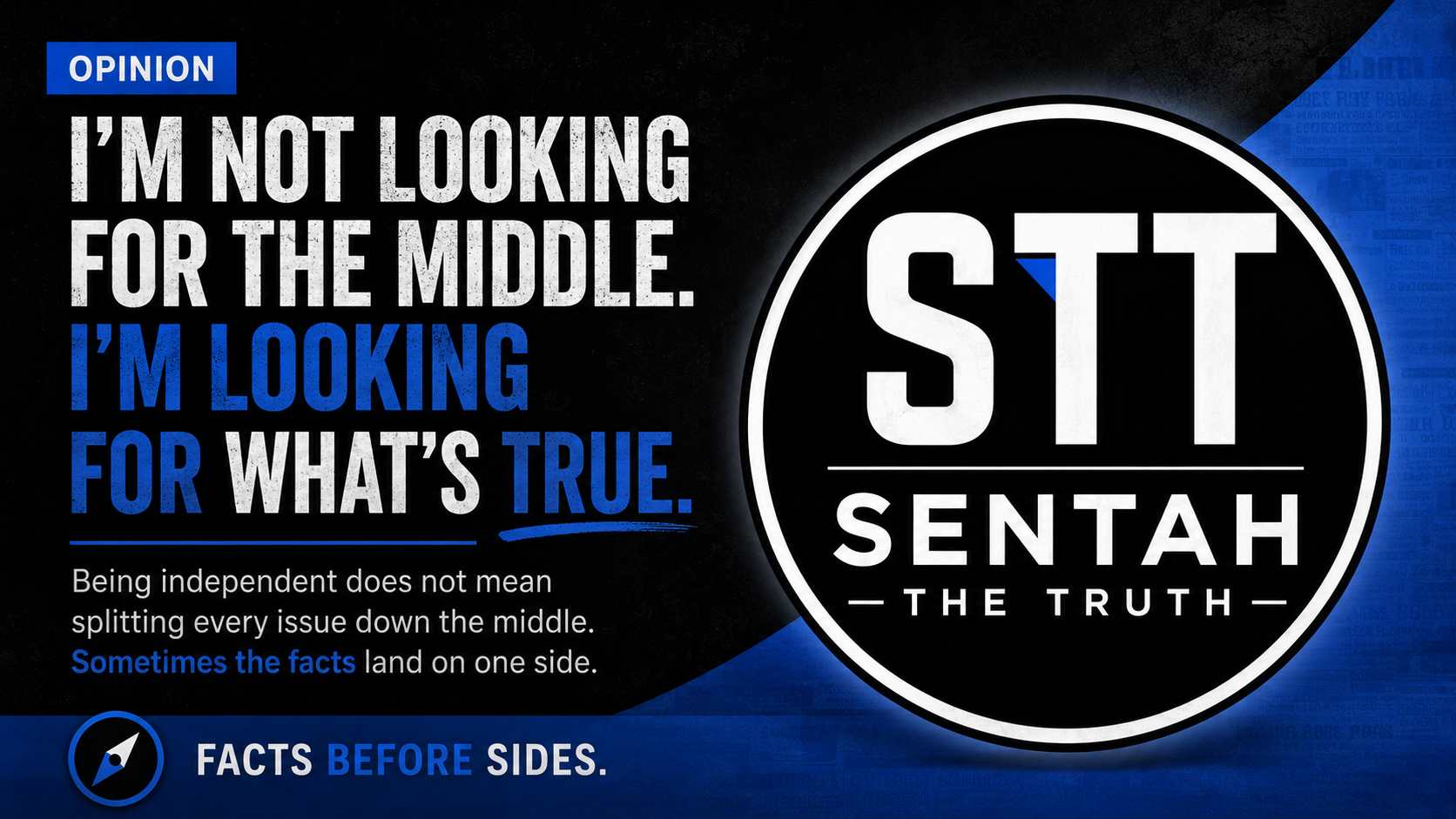
Because the goal should not be to find the middle.
The goal should be to find what is true.
Sometimes the truth is uncomfortable for conservatives.
Sometimes it is uncomfortable for liberals.
Sometimes it embarrasses Republicans.
Sometimes it embarrasses Democrats.
And sometimes the facts expose that both sides are more interested in winning the argument than understanding the issue.
That is where an independent publication should live.
Not in the middle.
In the evidence.
False balance is not independence
There is a lazy version of “balanced journalism” that says every story needs two equal sides.
One person says the sky is blue.
Another says it is green.
So the headline becomes:
Experts Divided Over Color of Sky.
That is not balance.
That is refusing to make a judgment when the evidence allows one.
Facts do not owe political parties equal treatment.
If one side makes a claim that is well supported and the other makes one that collapses under scrutiny, the responsible thing is to say so.
Independence does not mean forcing every conclusion into a 50/50 split.
It means applying the same standard to everyone.
Political tribes make that difficult
Partisan politics rewards loyalty.
Once people identify strongly with a party or political movement, information often gets filtered through a simple question:
Does this help my side or hurt my side?
That is a terrible way to evaluate evidence.
If a government program works, its effectiveness should not depend on which party created it.
If a policy fails, its failure should not become invisible because the politician responsible wears the right jersey.
If a Republican makes a factual claim supported by strong evidence, that claim does not become less true because Democrats dislike the speaker.
If a Democrat makes a factual claim supported by strong evidence, the same rule applies.
Truth does not become partisan because somebody inconvenient said it.
Changing your mind should not be embarrassing
One of the strangest features of modern politics is the expectation that people should never change their minds.
Politicians get attacked for changing positions.
Commentators dig up statements from ten years ago.
Voters treat consistency as proof of character even when new evidence emerges.
But refusing to change your conclusion after the facts change is not strength.
It is stubbornness.
If better evidence appears tomorrow, the responsible response is:
I was wrong.
That sentence should not destroy credibility.
Used honestly, it should build it.
A publication committed to facts should be willing to correct itself publicly, change conclusions when the evidence changes, and acknowledge uncertainty when certainty is not justified.
That is not weakness.
That is the entire point.
Outrage has a business model
There is another reason independent thinking is difficult.
Outrage works.
It gets clicks.
It gets shares.
It keeps people watching.
It gives audiences a villain and a hero.
Nuance is much harder to sell.
“Everything is complicated and we need more evidence” rarely goes viral.
“This person is destroying America” does.
That creates incentives throughout the media ecosystem.
Audiences learn to expect confirmation.
Politicians learn to perform for those audiences.
Media outlets learn that anger is profitable.
And eventually, every story becomes another piece of evidence that the other side is evil.
That may be good for engagement.
It is terrible for understanding.
Being independent does not mean being apolitical
This matters.
Independence should not become an excuse for avoiding difficult conclusions.
There are times when government policy is wrong.
There are times when corporations behave badly.
There are times when activists exaggerate.
There are times when institutions fail.
There are times when one political party is simply more responsible for a particular outcome than another.
Saying that clearly is not partisan if the evidence supports it.
The standard should be simple:
Would we apply the same judgment if the names and parties were reversed?
If the answer is no, then we probably are not applying a standard.
We are applying loyalty.
“Common sense” is not enough either
People love the phrase “common sense.”
It sounds reasonable.
It sounds independent.
But common sense can be wrong.
History is full of ideas that once felt obvious and turned out to be false.
That is why evidence matters.
A good argument should survive contact with data.
A strong opinion should still acknowledge inconvenient facts.
And a publication should distinguish clearly between:
Here is what happened.
Here is what the evidence suggests.
and
Here is what we think should happen next.
Those are not the same thing.
So what does “Facts Before Sides” actually mean?
It means we do not begin with the conclusion.
We begin with the question.
We look for primary sources.
We read the law instead of only reading somebody’s description of the law.
We look at the data behind the statistic.
We distinguish allegations from findings.
We distinguish economic activity from government revenue.
We distinguish a court’s procedural ruling from a final ruling on constitutionality.
We distinguish fraud investigations from proof that fraud occurred.
And then we tell readers what we found.
Even when the answer is inconvenient.
Especially when the answer is inconvenient.
The middle is sometimes right
And sometimes it is not.
There are issues where compromise makes sense.
There are issues where one side has stronger evidence.
There are issues where everyone is arguing about the wrong question.
The idea that truth must always sit exactly halfway between two political positions is itself a kind of ideology.
Sentah the Truth is not built around that idea.
We are not trying to be left.
We are not trying to be right.
And we are not trying to manufacture a perfect center.
We are trying to apply one standard.
To everyone.
That is harder than picking a team
Picking a team is easy.
You inherit the talking points.
You inherit the heroes.
You inherit the villains.
You know which stories deserve outrage before you even read them.
Independence is messier.
Sometimes you disappoint people who agreed with you yesterday.
Sometimes you defend someone you dislike because the criticism against them is unfair.
Sometimes you criticize someone you generally agree with because the evidence demands it.
That is the cost.
And it is worth paying.
Because if the purpose of journalism is merely to reassure readers that their political tribe is correct, we already have plenty of places doing that.
We do not need another one.
We need places willing to say:
Here is what we know.
Here is what we do not know.
Here is where the evidence points.
And if tomorrow’s evidence points somewhere different, we will tell you that too.
I’m not looking for the middle.
I’m looking for what’s true.
Facts before sides.