The Arizona Cardinals have their initial 53-man roster.
“Initial” is an important word.
NFL rosters rarely stay untouched after cutdown weekend. Waiver claims, trades, injuries and practice-squad moves can change the bottom of a roster almost immediately.
But Arizona’s decisions Sunday still gave us the clearest picture yet of the team Mike LaFleur will take into his first regular season as Cardinals head coach.
And perhaps the biggest story isn’t one of the players Arizona released.
It is the veteran running back who remains part of the plan — but won’t be available when the season begins.
JAMES CONNER WILL MISS AT LEAST FOUR GAMES
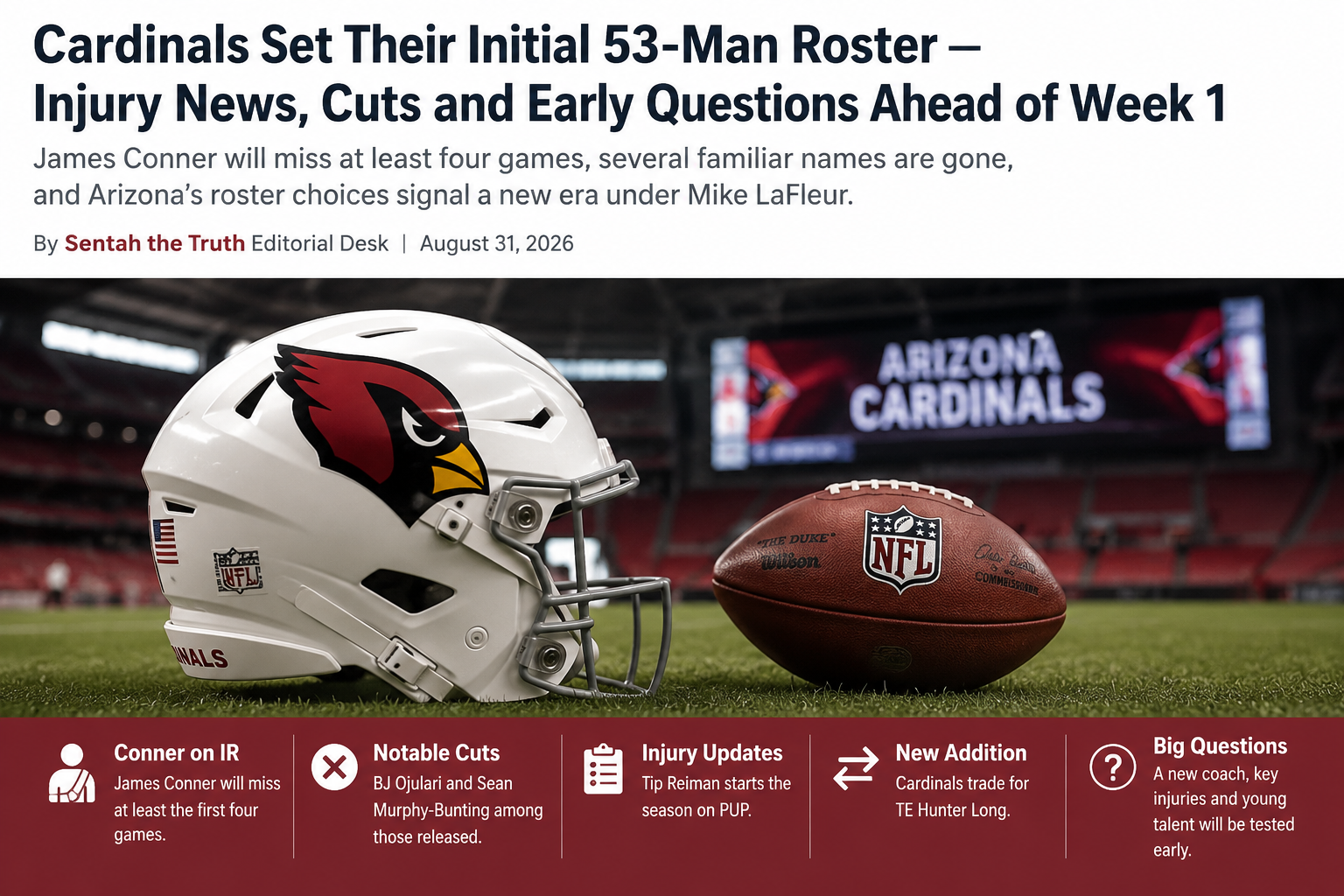
The Cardinals placed James Conner on injured reserve with a designation to return.
That means Conner must miss at least the first four games of the regular season.
Conner has been working his way back after suffering a serious foot injury last season. Arizona had hoped to have the veteran running back available early, but the roster move makes clear that his return will require more time.
It also immediately changes the equation in Arizona’s backfield.
Without Conner, the Cardinals will have to lean on their other running backs to carry the early-season workload.
That is more than a depth-chart adjustment.
Conner has been one of Arizona’s most dependable offensive players when healthy, and his physical running style has given the Cardinals an identity on the ground.
Now the offense will begin the LaFleur era without him.
SOME FAMILIAR NAMES ARE GONE
Cutdown day also brought some notable departures.
The Cardinals released outside linebacker BJ Ojulari and cornerback Sean Murphy-Bunting.
Ojulari’s departure is particularly notable because Arizona selected him in the second round of the 2023 NFL Draft. Injuries repeatedly interrupted his development, including a torn ACL that wiped out his 2024 season.
Murphy-Bunting arrived in Arizona as a veteran free-agent addition in 2024. His release signals that the Cardinals are comfortable moving forward with a younger-looking secondary.
Neither move alone defines the roster.
Together, though, they reinforce something about this version of the Cardinals: draft position, previous contracts and name recognition were not enough to guarantee a spot.
ANOTHER INJURY AFFECTS THE OFFENSE
Tight end Tip Reiman will begin the season on the physically unable to perform list, meaning he also will miss at least the first four games.
Arizona addressed its tight-end depth before the roster deadline by acquiring Hunter Long in a trade.
Trey McBride remains the centerpiece of the position and one of the most important players on Arizona’s entire offense.
But Reiman’s absence creates another early-season depth issue that the Cardinals needed to address before Week 1.
A ROSTER BUILT AROUND A DIFFERENT COACH
This is also the first roster constructed for LaFleur as head coach.
That matters.
Every coaching change alters what a team values.
Players who fit one system may not fit another. Certain position groups become more important. Coaches prioritize different traits, and veterans who once seemed secure can suddenly find themselves competing with younger or less expensive players.
General manager Monti Ossenfort remains responsible for assembling the roster, but this is now a roster designed to function within LaFleur’s vision.
The Cardinals are no longer simply adjusting the team they had.
They are beginning to shape the team their new coach wants.
THE PRACTICE SQUAD IS ALREADY TAKING SHAPE
Several players who did not make the 53-man roster are already returning on the practice squad.
Arizona announced Monday that it had re-signed 14 players, including cornerback Starling Thomas V.
That is another reason not to treat Sunday’s cuts as a final verdict on every player involved.
The modern NFL practice squad functions as an extension of the active roster. Injuries and weekly matchup decisions regularly move players between the two.
Some of the players released Sunday will almost certainly appear in Cardinals uniforms this season.
WHAT DOES THE ROSTER TELL US?
The most important takeaway may be that Arizona enters the regular season with legitimate uncertainty.
There is a new head coach.
There are injuries to important offensive players.
There are younger players being asked to assume larger roles.
And there are several roster decisions that suggest the organization is willing to move on from familiar names rather than preserve the status quo.
That does not automatically make the roster better.
It does make it different.
Now comes the part that determines whether those decisions were right.
Preseason evaluations are over. The roster has been cut down. The depth chart is becoming real.
The Cardinals now have to find out whether the team they assembled can win regular-season football games.
And they will begin that test without James Conner.