Parents have heard the argument before
Your kid spends too much time on Instagram?
Take the phone away.
They’re staying up all night scrolling?
Set a bedtime.
They’re seeing things online they shouldn’t?
Monitor them.
There’s truth in all of that.
Parents have responsibility for what their children do online.
But there’s another question increasingly being asked in courtrooms across America:
What responsibility does the company on the other side of the screen have?
That question is now at the center of one of the biggest legal challenges the social-media industry has faced.
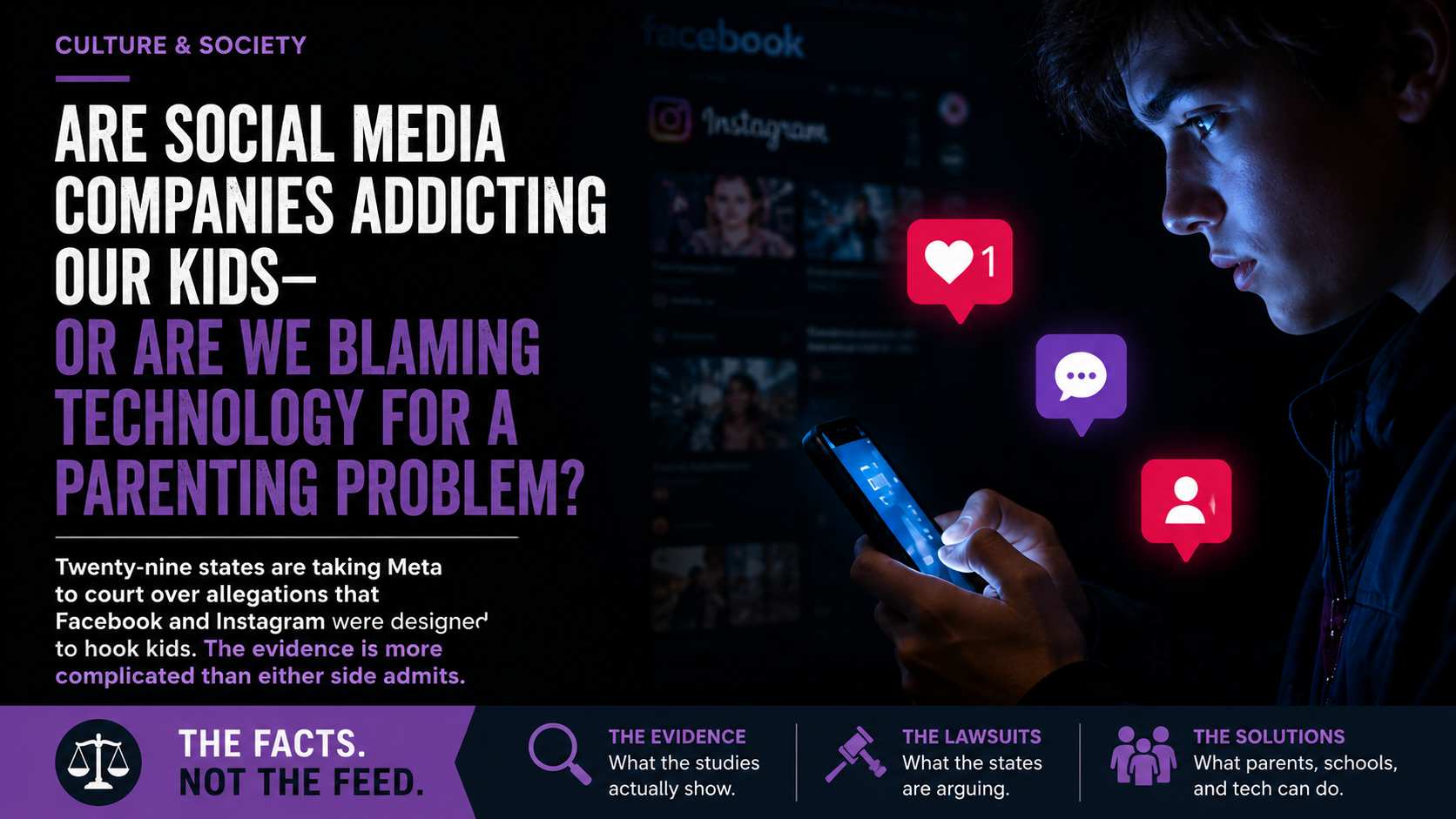
Twenty-nine states are taking Meta to court
A bipartisan coalition of 29 states is currently pursuing Meta, the parent company of Facebook and Instagram, in federal court in California.
The states allege Meta deliberately designed features to keep young people engaged, collected information from children under 13 without proper parental consent and misrepresented aspects of the safety of its platforms.
Meta denies the allegations.
Its attorneys argue that the states are overstating both what the scientific evidence establishes and Meta’s responsibility for harms experienced by young users. Meta also points to safety tools and changes it has introduced for teenagers.
That’s important.
These are allegations being litigated.
They aren’t facts merely because a government attorney put them in a lawsuit.
But the allegations are serious enough that the evidence deserves examination.
What does “designed to be addictive” actually mean?
Nobody needs to imagine a sinister executive sitting in a room saying, “Let’s addict children.”
The debate is largely about product design.
Think about how social media works:
Infinite scrolling.
Push notifications.
Likes.
Recommended content.
Autoplay.
Personalized feeds.
Visible social approval.
The next piece of content is always waiting.
The American Psychological Association specifically identifies features including likes, recommended content and endless scrolling as design elements that deserve special consideration when platforms are used by adolescents.
The states’ argument is essentially that these aren’t neutral features.
They’re engagement tools.
And engagement makes money.
But does that mean social media causes mental illness?
This is where the story gets much less convenient.
The scientific evidence does not support the simple claim that social media is inherently harmful to every child.
The American Psychological Association says almost exactly the opposite:
Social media isn’t inherently beneficial or harmful.
Effects differ based on the child, the content, the features being used, existing vulnerabilities and the environment in which that child lives.
The federal government’s own assessment is similarly cautious.
The U.S. Surgeon General’s advisory concluded that we cannot yet say social media is sufficiently safe for children and adolescents.
That’s not the same as saying science has proven social media causes a particular mental-health condition.
There are still significant gaps in the evidence, particularly around causation and long-term effects.
That’s an important distinction.
Concern is justified. Certainty isn’t.
Social media can also help kids
This part tends to disappear from the argument.
For some young people, social media provides connection they don’t have elsewhere.
It can help kids find communities based on hobbies, disabilities, identity or experiences that aren’t represented in their immediate environment.
The Surgeon General’s advisory acknowledges that online communities can provide social connection, self-expression and access to information.
The APA similarly notes potential psychological benefits, particularly for some marginalized young people seeking peer support or information.
So “social media is bad for children” isn’t particularly useful.
The better question is:
Which children, using which platforms, consuming which content, through which features, for how long?
That’s much harder to fit into a headline.
Then New Mexico changed the conversation
Earlier this month, a New Mexico court entered a massive judgment against Meta after litigation over child safety.
The total financial liability reached approximately $942 million, combining an earlier $375 million civil penalty with an additional $567 million judgment.
The court also imposed five years of supervised changes affecting how Facebook and Instagram operate for minors in New Mexico.
Among the ordered safeguards are restrictions involving teen screen time, notifications, interactions with adults and certain engagement features.
Meta is appealing.
So again:
The judgment is real. The legal fight isn’t necessarily finished.
Where do parents fit into this?
Right in the middle.
The existence of potentially manipulative technology doesn’t eliminate parental responsibility.
And parental responsibility doesn’t eliminate corporate responsibility.
The APA recommends adult monitoring, discussion, coaching and developmentally appropriate limits—particularly during early adolescence.
It also notes something adults may not enjoy hearing:
Our own behavior matters too.
Parents who are constantly checking phones while interacting with their children are modeling the same behavior they’re trying to regulate.
That’s worth sitting with.
It’s difficult to tell a 13-year-old that the phone is consuming their life while checking Facebook halfway through the lecture.
But “just take the phone away” doesn’t answer the corporate question
Imagine a company intentionally designs a product to maximize the amount of time adults spend using it.
That’s business.
Now imagine the company knows that children are using the same product.
That creates a different responsibility.
Children aren’t simply small adults.
Adolescent development involves heightened sensitivity to peer feedback and social reinforcement while self-regulation continues developing.
That’s part of why the APA recommends that product design and permissions be tailored to children’s developmental capabilities.
If the states prove Meta knowingly exploited those vulnerabilities while publicly minimizing the risks, “parents should parent” isn’t a complete defense.
If the states can’t prove that, the government shouldn’t win simply because social media makes people uncomfortable.
That’s what trials are for.
There’s enough responsibility to go around
Parents should know what their children are doing online.
Children need digital literacy.
Schools have a role.
Policymakers have a role.
Researchers need better access to data.
And technology companies shouldn’t get a free pass simply because parents technically have the ability to take a phone away.
This doesn’t have to be an either/or argument.
It can be:
Parents have responsibility for their children.
Companies have responsibility for the products they intentionally design.
Both statements can be true simultaneously.
So are social media companies addicting our kids?
We don’t have enough evidence to responsibly declare that social media itself “addicts children” across the board.
There is meaningful evidence that certain platform features can encourage prolonged engagement and that some young people are particularly vulnerable to negative effects.
There is also evidence that social media can benefit some young people.
And right now, a federal court is examining a much narrower factual question:
What did Meta know, what did it design, and what did it tell the public?
The states have made serious allegations.
Meta has a right to challenge them.
The evidence should decide the case.
Not our feelings about Big Tech.
Not our feelings about teenagers.
And not our feelings about parenting.
Because there’s plenty of responsibility to investigate on both sides of the screen.
Facts before sides.